
 OECD Competition Law and Policy
347d ago
OECD Competition Law and Policy
347d ago
▶
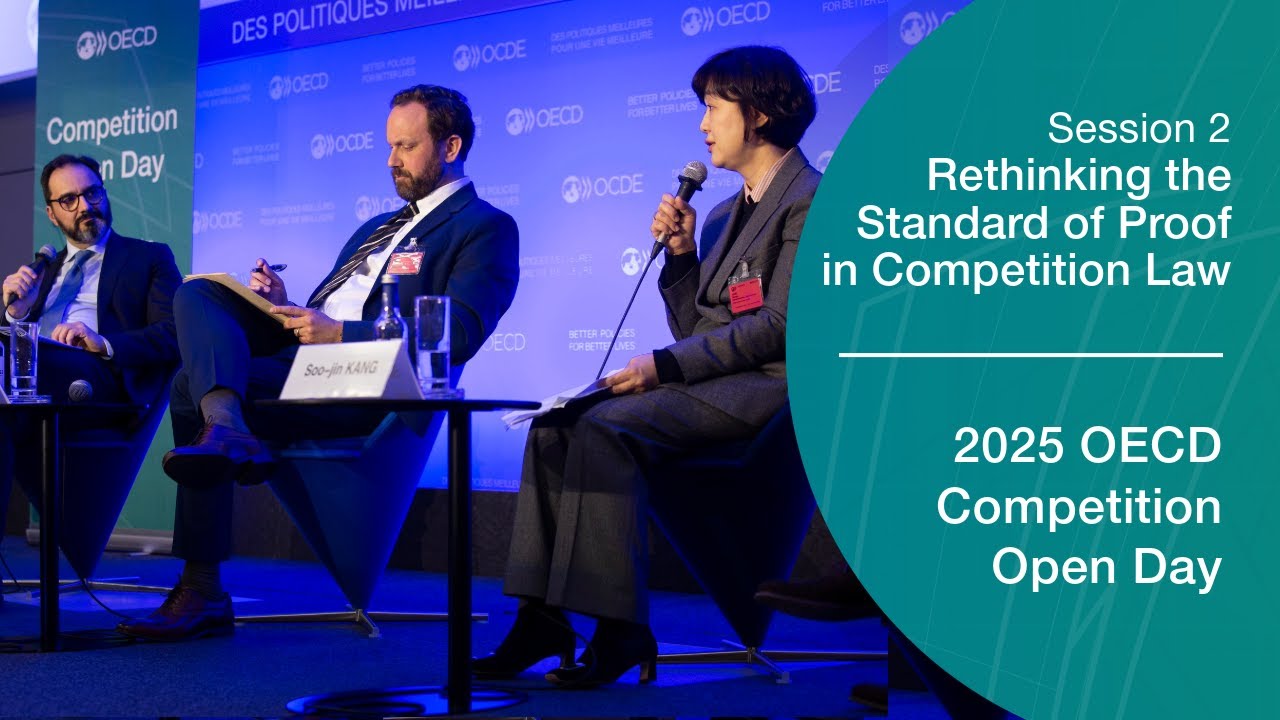
2025 OECD Competition Open Day - Session 2. Rethinking the Standard of Proof in Competition Law
The standard of proof is a core concept of competition law; it is the degree to which enforcers must prove their case to succeed in establishing the existence of a competition infringement or an anti-competitive merger. With the increasing complexity of establishing antitrust infringements, has the evidentiary standard been set too high? Could it be making it excessively difficult for competition authorities to prove their cases or block mergers? What about in assessments where concepts such as economic moats and entrenchment are involved? Should the standard of proof or the burden of proof be adjusted in the future?
This session moderated by Antonio Capobianco (Deputy Head, OECD Competition Division) brought together Daniel Haar (Chief, Appelate Section US DOJ), Marc van der Woude (President, General Court of the EU) ad Soo-jin Kang (Professor of Law, Korea University) to try to answer these questions.
Timecodes
0:00 Intro and key concepts
12:29 Is the evidentiary standard for proving anti-competitive practices too high?
24:32 Balancing the use of direct evidence with economic analysis in the U.S.
39:34 Should the standard of proof be adjusted based on the complexity of the case?
55:15 Should presumptions play a greater role in antitrust enforcement?
1:10:13 Q&A
More about the 2025 OECD Competition Open Day at https://oe.cd/comp-od25
More OECD work on competition at https://oe.cd/competition
Access more materials on the topic:
- Standard of proof - https://oe.cd/5OH
- Monopolisation, Moat Building and Entrenchment Strategies - https://oe.cd/mmbe