
 IISD Events
63d ago
IISD Events
63d ago
▶
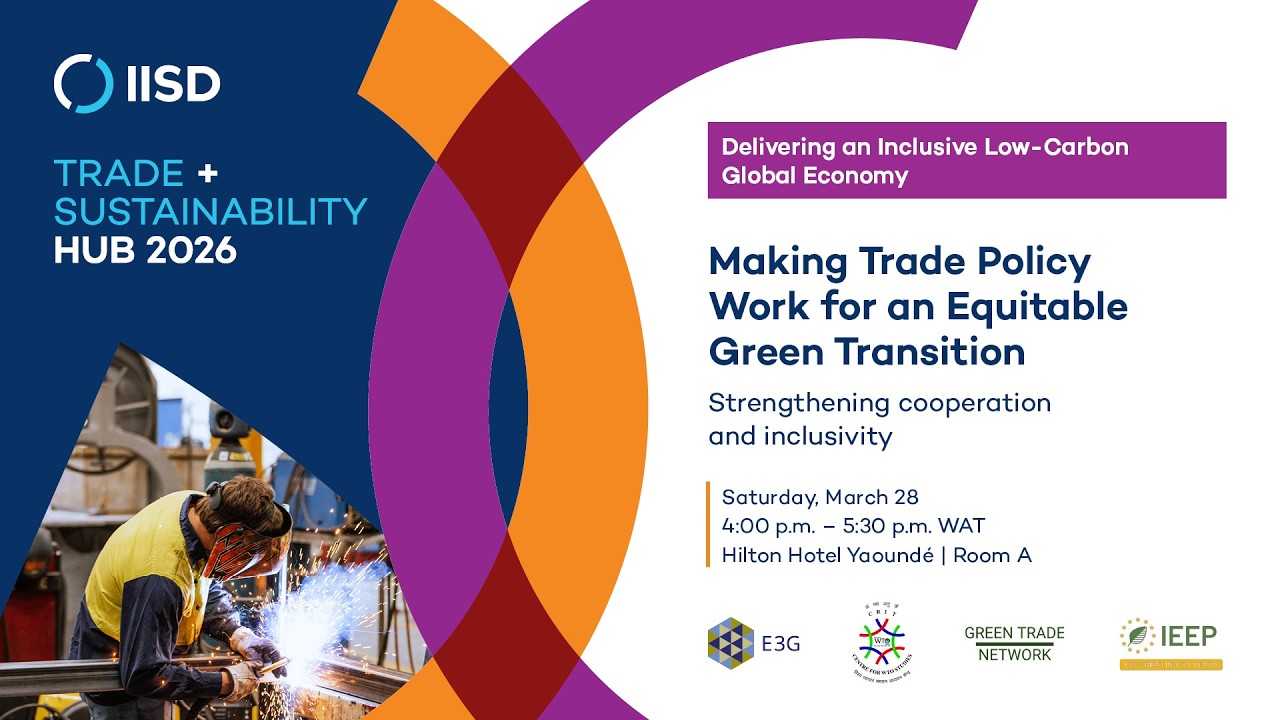
Making Trade Policy Work for an Equitable Green Transition: Strengthening cooperation & inclusivity
Building a sustainable, low-carbon economy is now a global necessity, but the pace and pathways of decarbonization remain deeply contested. As countries adopt divergent sustainability policies, the growing use of unilateral trade measures risks fragmenting global approaches and widening asymmetries between developed and developing economies. Strengthening international cooperation is essential to ensure coherence, fairness, and effectiveness in the low-carbon transition.
This session explored how developed and developing countries can design equitable, context-specific pathways that balance climate ambition with economic realities. Discussions focused on trade policy tools that support coordination and interoperability, as well as strategies for plurilateral and multilateral engagement, including collective responses to unilateral measures and enhanced North–South and South–South cooperation.
Participants identified practical approaches for aligning decarbonization with industrial competitiveness and a just transition, highlighting emerging cooperation models that support inclusive, development-oriented low-carbon growth.
Speakers
- Christophe Bellmann - Forum on Trade, Environment and the SDGs (TESS)
- Markus Gehring - University of Cambridge
- Vahini Naidu - South Centre
- Ellie Belton - E3G
- Pierre Leturcq - Institute for European Environmental Policy (IEEP)
- Pritam Banerjee - Centre for WTO Studies