
 IISD Events
65d ago
IISD Events
65d ago
▶
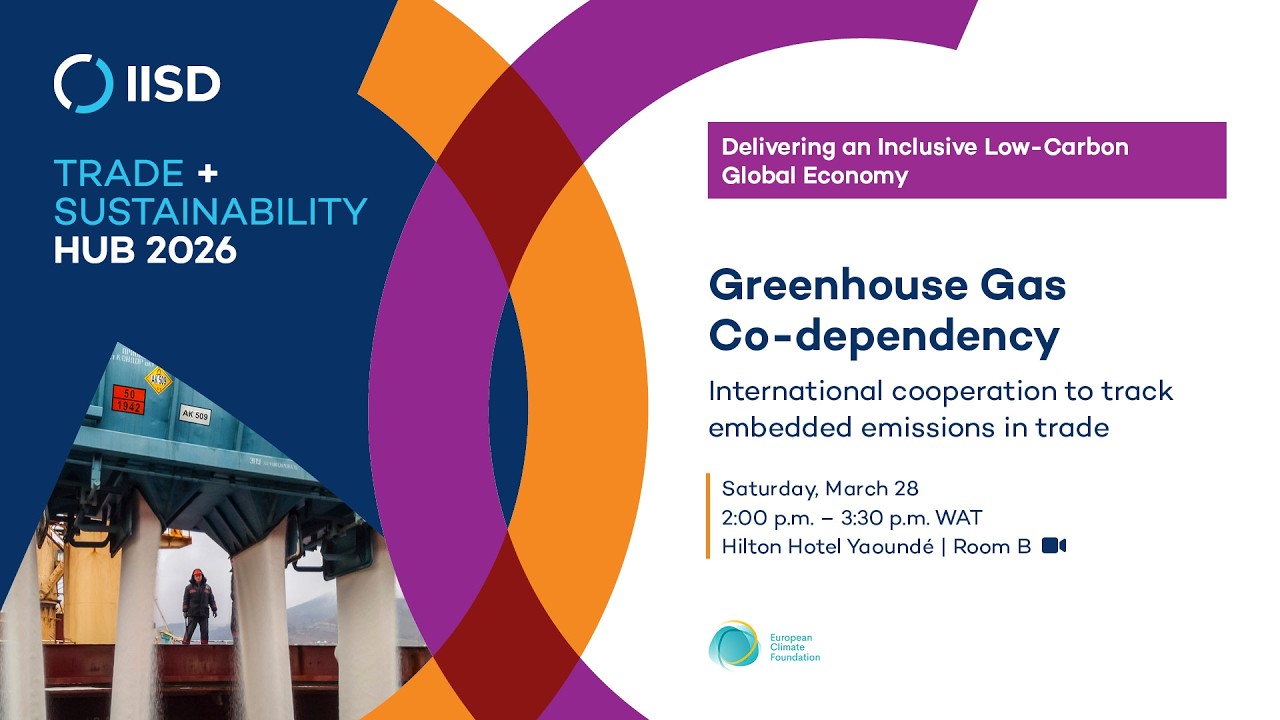
Greenhouse Gas Co-dependency: International cooperation to track embedded emissions in trade
The World Trade Organization (WTO) reports that approximately one-third of global GHG are released in the production of internationally traded products, ranging from agricultural commodities, to steel, fertilizers, aluminum, cars and myriads of other consumer products, and the fossil fuels used to move them across borders. Parties to the United Nations Framework Convention on Climate Change (UNFCCC) are responsible for their territorial emissions, yet there is a growing recognition that this approach misses an often substantial share of so-called imported emissions. This goes beyond the recent attention given to the risk of “carbon leakage” – an increase in emissions in one country resulting from mitigation policies introduced by another – because traded emissions are often cross-sectoral. It also stems from a co-dependence between trading partners on climate: one country’s imports drive another’s emissions.
In this session, the European Climate Foundation presented preliminary data on the “hotspots” of GHG in internationally traded products and why leaving the emissions embedded in trade unaddressed risks a growing blind spot in decarbonization efforts. Panelists had the opportunity to discuss emerging efforts their countries are taking on the issue, along with reflections on what is needed to build a wider coalition on addressing trade-embedded GHGs.
Speakers
- Sean Doherty - World Economic Forum
- Richard Baron - European Climate Foundation
- Takaaki Sashida - Permanent Mission of Japan to the International Organizations in Geneva
- Alice O’Reilly - Australian Government
- Markus Gehring - University of Cambridge
- Pierre Leturcq - Institute for European Environmental Policy (IEEP)