
 UNDP Innovation
10d ago
UNDP Innovation
10d ago
▶
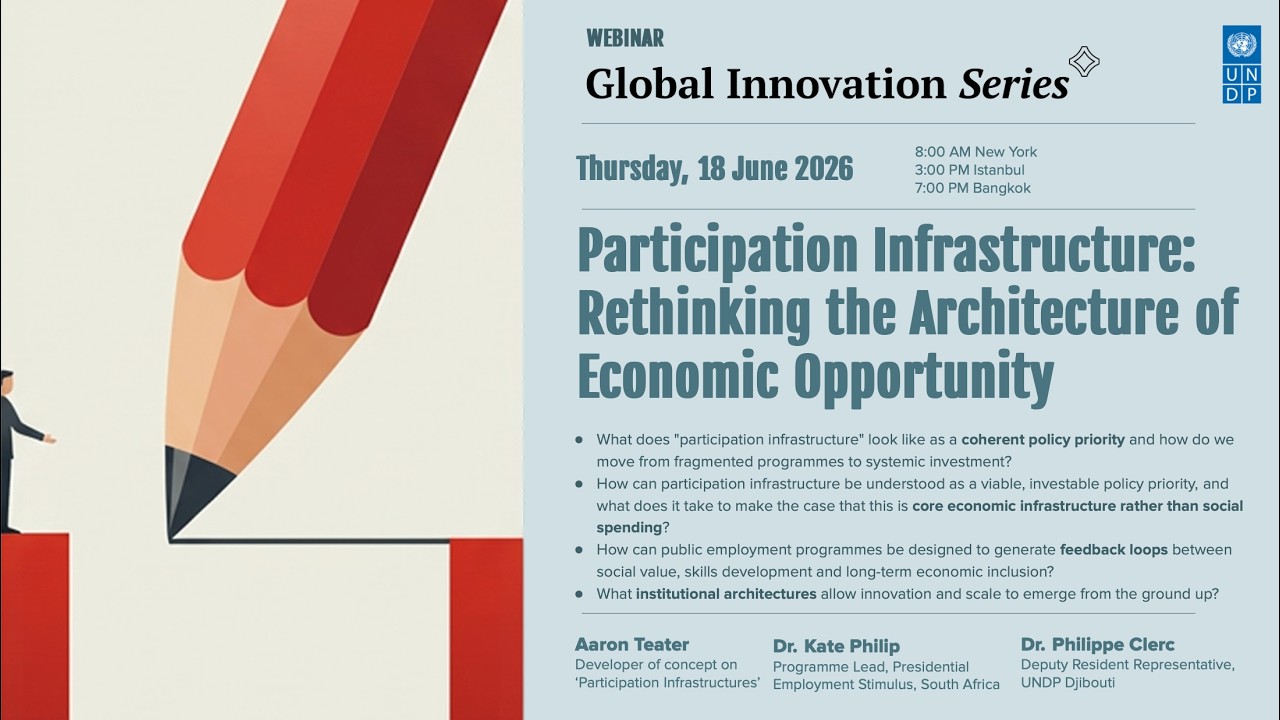
Participation Infrastructure: Rethinking the Architecture of Economic Opportunity
What if the global employment crisis is less a matching problem and more an architecture one? Join us for a conversation with Aaron Teater, Public Sector Innovation consultant at Basis and the mind behind the concept of ‘Participation Infrastructures’, Dr. Kate Philip, Programme Lead of the Presidential Employment Stimulus in South Africa, and Dr. Philippe Clerc, Deputy Resident Representative of UNDP Djibouti.
Despite decades of investment in private sector development, investment climate reform and skills training, the gap between human potential and economic opportunity persists. Over 400 million people who want work cannot find it (ILO). Youth unemployment sits at 13% globally, rising to 27% in low-income economies. This mismatch doesn't self-correct, it compounds, eroding skills, fracturing communities and turning temporary crises into permanent structural decline.
A growing body of thinking suggests the problem may be architectural. A single parent retraining for a growing industry faces a prohibitive stack of transaction costs (tuition, childcare, transport, lost income) that have nothing to do with their talent or ambition. The barrier is the absence of what Aaron Teater calls participation infrastructure: the systems, institutions and mechanisms that determine whether talent and opportunity ever find each other.
This lens recasts issues typically siloed as social policy (childcare), education (tuition) or mobility (transport) into a unified economic infrastructure challenge. It is not an entirely new idea, the military has long understood that reducing the cost of participation to near zero, from recruitment through to housing, training and the GI Bill, is what makes it possible to reach the people it needs. The question is what it would mean to bring that same intentionality to the economic pathways societies most urgently need and to build them for everyone.
Join us for a discussion exploring what this reframing means in practice:
- What does "participation infrastructure" look like as a coherent policy priority and how do we move from fragmented programs towards more systemic investment?
- How can participation infrastructure be understood as a viable, investable policy priority, and what does it take to make the case that this is core economic infrastructure rather than social spending?
- How can public employment programs be designed to generate feedback loops between social value, skills development and long-term economic inclusion?
- What institutional architectures allow innovation and scale to emerge from the ground up and what can Djibouti and South Africa's experience teach us about building systems that hold?