
 Project Drawdown
119d ago
Project Drawdown
119d ago
▶
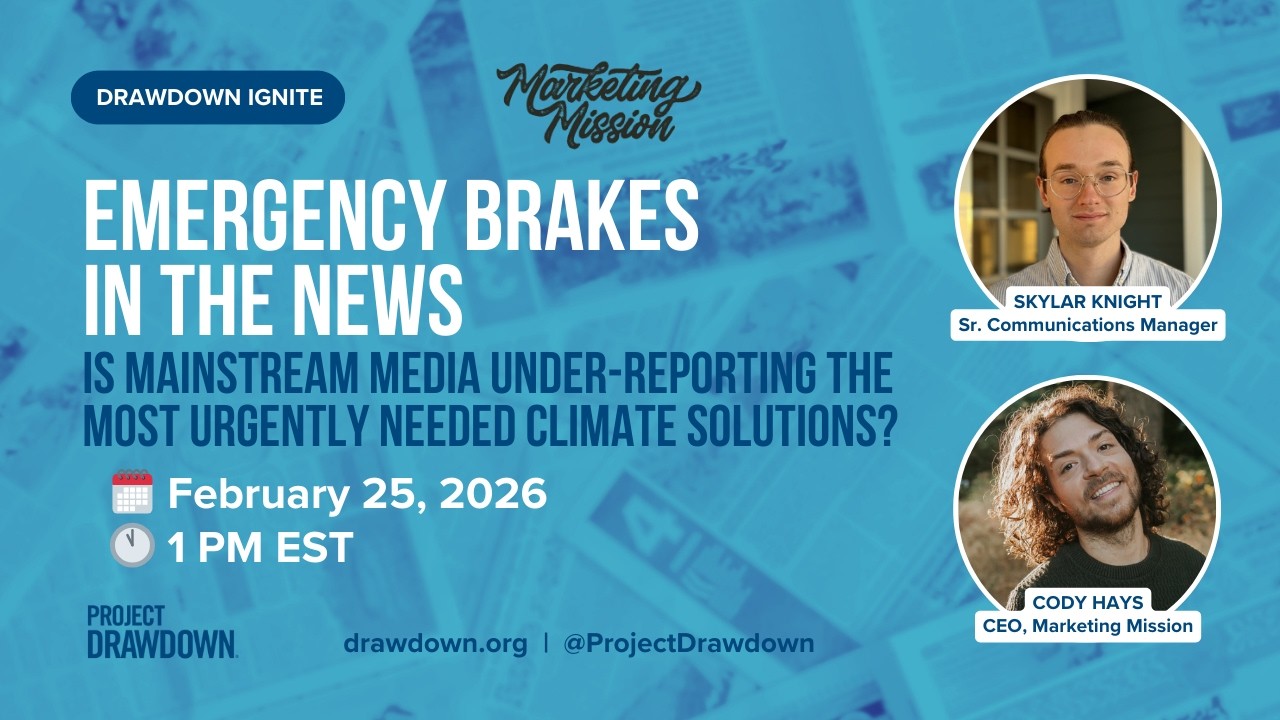
Emergency Brakes in the News: Is mainstream media underreporting urgently needed climate solutions?
Emergency brake climate solutions are among the most important to implement today. By rapidly reducing potent pollutants, such as methane, or preventing large pulses of emissions from entering the atmosphere in the first place, emergency brakes can slow near-term warming, buying us sorely needed time as other solutions develop and scale. Yet, most emergency brake solutions are rarely covered by the media, leading to a lack of attention and awareness necessary to advance them.
In this Drawdown Ignite webinar, Arizona State University doctoral student Cody Hays and Project Drawdown Senior Communications Manager Skylar Knight share the results of a collaborative research project analyzing the coverage of emergency brake climate solutions in three leading United States-based media outlets. Watch to learn about why emergency brake solutions and solutions journalism are so important, which solutions are least or most covered, and how large the gap is between media coverage and the potential emissions impact of more than a dozen emergency brakes.
Whether you are a journalist looking for underreported solutions to cover, a researcher interested in the intersection of media and climate, or a climate-concerned individual who is curious about solutions that the media is missing, be sure to watch for a first look at this exciting new research.
KEY TAKEAWAYS
1) Emergency brake solutions that act on super-pollutants like methane or prevent pulses of emissions are critical for stopping climate change
2) Emergency brake solutions can avert the worst impacts of climate change and buy us time while infrastructure, nature-based solutions, and new technologies develop
3) Traditional or legacy media remains a vital source of trustworthy information for most Americans
4) Emergency brake solutions are severely underreported across three major U.S. outlets compared to their impact on climate change
5) Just three emergency brakes – Improve Diets, Increase Centralized Composting, and Protect Forests – accounted for nearly 80% of all coverage
6) Of the three outlets analyzed, The Guardian had by far the most coverage of emergency brake solutions
7) Coverage is biased toward “doable and depictable” solutions that are more likely to resonate with readers and the actions they are able to take
SPEAKER BIOS
Skylar Knight is the senior communications manager at Project Drawdown, where he leads media outreach and supports communications across all of the organization’s owned channels. From placing stories in the world's most widely read publications to leading multichannel communication campaigns, Skylar strives to ensure the climate crisis and those working to solve it get the spotlight they deserve. He is the former managing editor of bioGraphic magazine and holds a graduate degree in science communication from Imperial College London.
Cody Hays is a doctoral researcher at the Walter Cronkite School of Journalism and Mass Communication at Arizona State University. Their research focuses on climate communication, public understanding of science, and the role of misinformation in shaping environmental attitudes. Their current work examines how ideological worldviews and trust in scientific institutions influence responses to politically divisive issues like climate change. They bring over a decade of experience in nonprofit advocacy and science communication, having led campaigns that secured more than $6 million in environmental funding.