
 Regulatory Assistance Project
202d ago
Regulatory Assistance Project
202d ago
▶
Unlocking Cost-Effective Grid Flexibility in Thailand: VPPs and the Role of Regulators
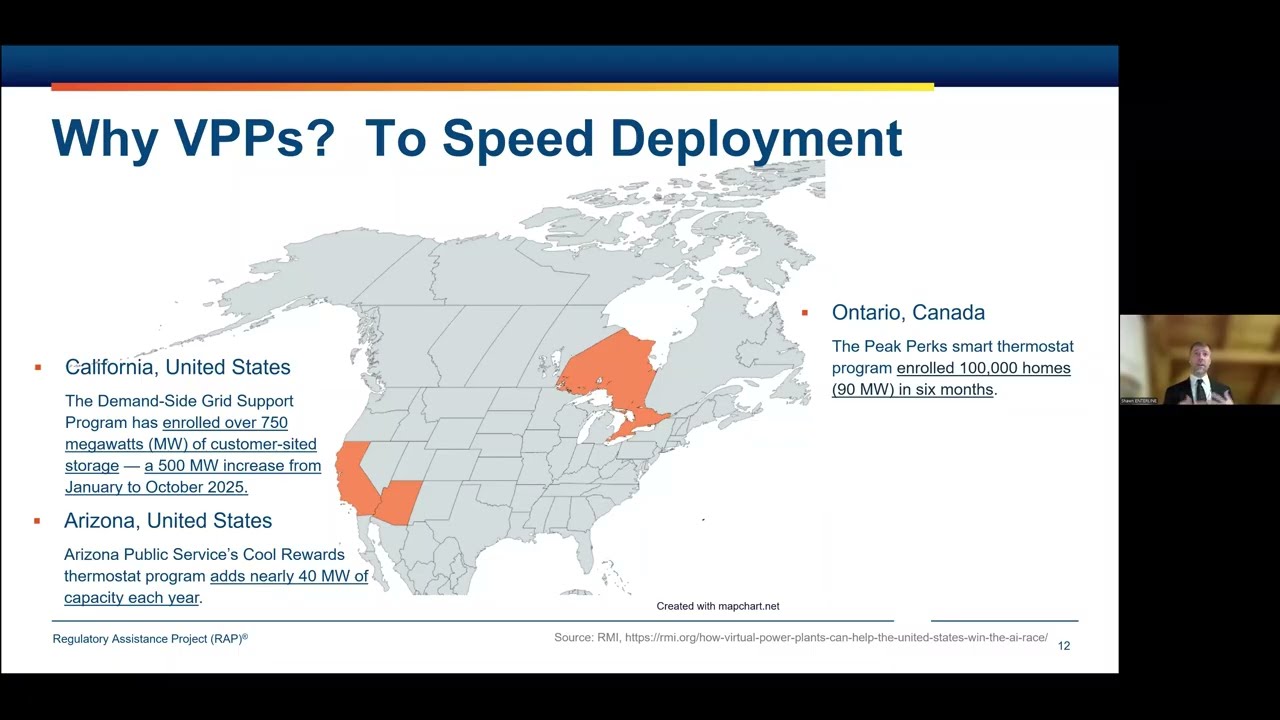
Virtual power plants (VPPs) provide grid services at a lower cost, and can be deployed faster, than conventional generation. Studies have found that VPPs can provide resource adequacy at 40% to 60% of the cost of alternatives like gas-fired peaking plants or peak shaving batteries. In addition, they can be deployed in a matter of months, far faster than the 3–5+ years that it takes to deploy conventional generation.
The Regulatory Assistance Project and the Regulatory Energy Transition Accelerator held a webinar on November 20, 2025, on how VPPs can deliver cost-effective flexibility in both market-oriented electricity services and in vertically integrated systems. Additionally, our experts explored how Thailand can incorporate this technology into its vertically integrated system.
We shared insights from our new report, Unlocking Cost-Effective Grid Flexibility in Thailand: Virtual Power Plants and the Role of Regulators (https://www.raponline.org/knowledge-center/unlocking-cost-effective-grid-flexibility-virtual-power-plants-thailand-role-of-regulators/). The speakers highlighted experience with different business models, including:
-- Hawaii’s utility-led VPP model
-- Australia’s market-led VPP model
-- Policy pathways for VPPs in Thailand
-- Practical recommendations for regulators interested in advancing VPPs in their jurisdictions
We were joined by the following speakers and panelists.
Opening remarks:
-- Poonpat Leesombatpiboon (ERC)
-- Phuwanart Choonhapran (ERC)
Speakers:
-- Jay Griffin (RAP)
-- Lakin Garth (SEPA)
-- Shawn Enterline (RAP)
Panelists:
-- Surat Asvapoositkul (EGAT)
-- Peerapat Vithayasrichareon (IEA)
-- Grayson Heffner (Southeast Asia Grid Consultant)
-- Alejandro Hernández (RAP)
The successful integration of virtual power plants (VPPs) into the electric grid holds the potential to unlock cost-effective grid flexibility and help accelerate the clean energy transition.