
 CEPR & VideoVox Economics
75d ago
CEPR & VideoVox Economics
75d ago
▶
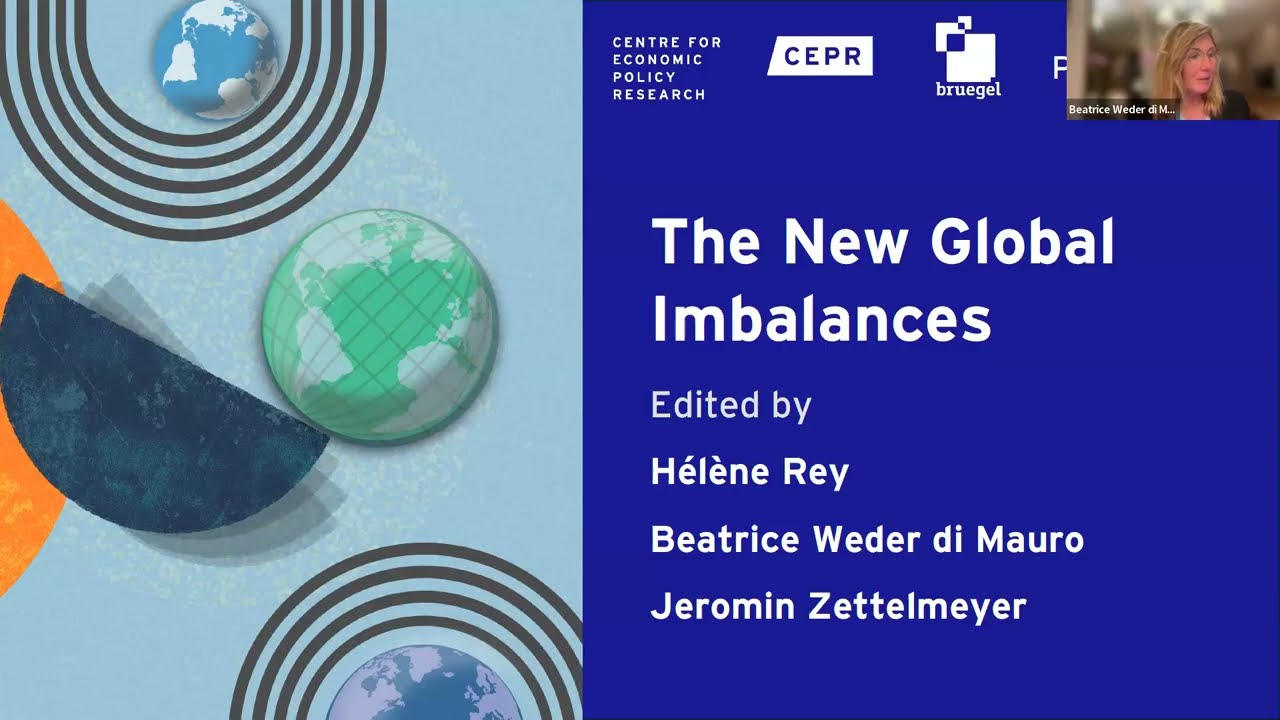
Online Launch of Paris Report 4: The New Global Imbalances
The Fourth Paris Report, entitled The New Global Imbalances, examines the return of global imbalances to the centre of international economic debate at a time of rising geopolitical tension, financial fragility, and shifting trade dynamics. While not unprecedented in size, today’s imbalances reflect deeper structural forces: persistent US deficits financed by increasingly volatile private capital flows, rising surpluses in China, and excess savings in Europe. The report argues that, in a high-debt and fragmented world, these imbalances pose renewed risks to financial stability, fuel protectionism, and threaten the foundations of the global trading system.
With the United States, China, and Europe at the core of the global economy, the report sets out a framework for coordinated rebalancing: raising public saving in the US, boosting domestic consumption in China, and increasing productive investment in Europe. At the same time, it recognises that such coordination may prove elusive. It therefore explores contingent strategies for the rest of the world: strengthening resilience to financial shocks, managing the effects of Chinese industrial surge in exports, and safeguarding rules-based trade in an era of growing unilateralism.
This report forms the latest output of the joint CEPR-Bruegel initiative, Important Topics of Common European Interest (ITCEI). The editors, Hélène Rey (London Business School and CEPR), Beatrice Weder di Mauro (Geneva Graduate Institute and CEPR), and Jeromin Zettelmeyer (Bruegel and CEPR), bring together a set of contributions that explain why global imbalances matter again, what has changed since the pre-crisis era, and how policymakers should respond in a world of heightened uncertainty and diminished cooperation.
The result is both a diagnosis and a call to action: without policy adjustment, global imbalances are unlikely to unwind smoothly, but instead risk correcting through financial stress, trade conflict, or both.
Join Hélène Rey, Beatrice Weder di Mauro, Jeromin Zettelmeyer, and chapter authors Ravi Balakrishnan, Takeo Hoshi, Yiping Huang, Isabelle Mejean, Gian Maria Milesi-Ferretti and Maurice Obstfeld for an online presentation and discussion of the Report.