
 Geneva Environment Network
12d ago
Geneva Environment Network
12d ago
▶
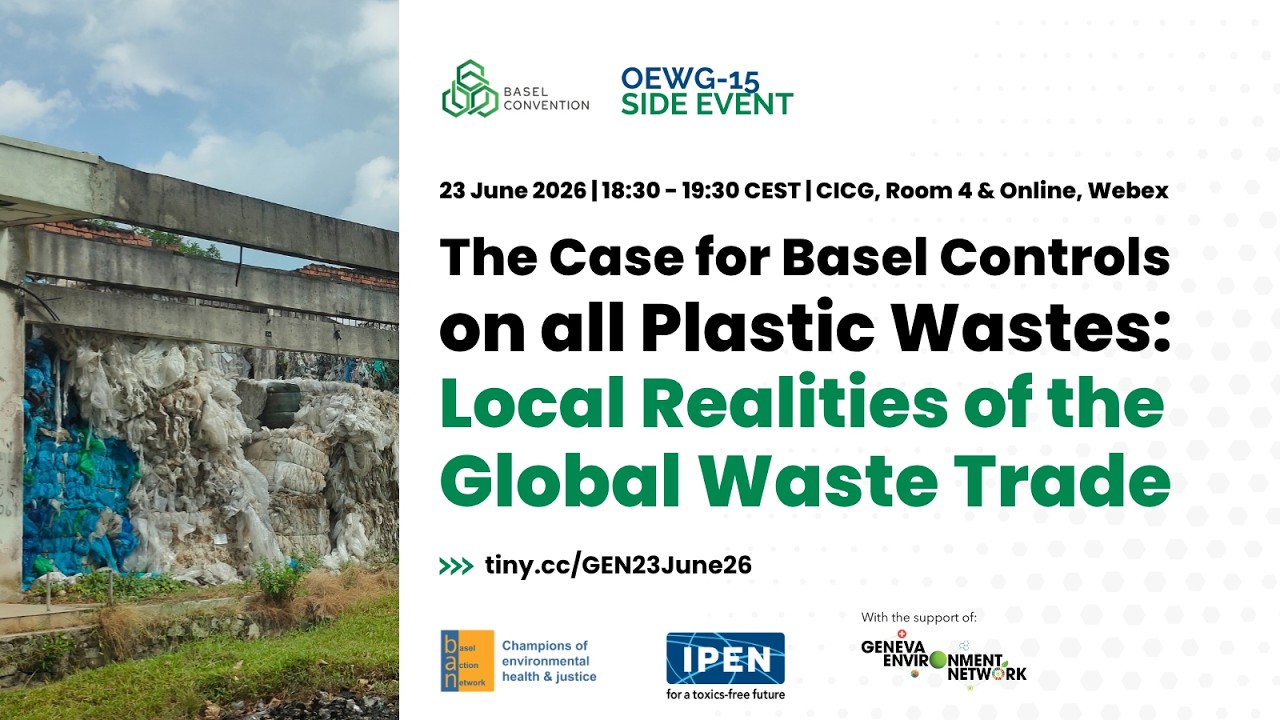
The Case for Basel Controls on all Plastic Wastes: Local Realities of the Global Waste Trade
In 2019, during the Plastic Waste Amendment (PWA) negotiations, China at Basel COP14 proposed that the Basel Convention control all plastic wastes, regardless of their destinations or hazardousness. However, that proposal did not succeed and several types of plastic waste remain exempted from Basel controls.
A few years later, Switzerland and Ghana proposed that we do precisely that for all forms of electronic waste. The Basel Parties agreed and created the E-Waste Amendments, which placed all exports of e-wastes under Basel control procedures, without any listings that are exempt.
This year, beginning May 21, 2026, all 27 member states of the EU require prior informed consent (PIC) for all plastic waste leaving the EU under their revised Waste Shipment Regulation, regardless of whether the waste is going to OECD or non-OECD countries, or whether they are hazardous or not.
The notion of controlling all plastic waste trade is an idea whose time has come.
A lot has changed since 2019 when the PWAs were passed. Even though the Plastic Treaty negotiations have been delayed, it has become abundantly clear that the reason why a treaty has not been agreed upon is not due to the fact that plastic is not a serious pollutant throughout its entire lifecycle, but rather, due to the lack of political will to stem the tide of virgin plastic production.
Over the years, we have gathered a significant amount of new scientific knowledge about the harm of plastic. We now know that plastic is in fact toxic, with more than 16,000 chemicals being used in its production, and more than 4,200 are chemicals of concern, which are persistent, bioaccumulative, mobile or toxic. Plastic also releases harmful microplastics at every stage of its production, consumption and waste management. We have also learned that plastic is not inherently circular – the number of times the material can be recycled is limited, and contaminants are found in recycled pellets, with the risk of being recycled into new products.
We know that almost all plastic waste trade is driven, not by a need to increase recycling or circularity, but by the economic incentive to exploit cheaper labour, lower energy costs, and weaker legal safeguards for human and environmental health in importing countries.
Case studies from Tunisia, Malaysia, and Australia will demonstrate how the trade in household waste, textile waste, plastic waste, and refuse derived fuel are under-regulated, avoiding tracking and PIC procedures, leading to de facto waste dumping from wealthy countries to lower-income countries. One case demonstrates how the Basel convention waste codes can be applied to improve local outcomes and support the spirit and intent of the plastic waste amendments.
It has become clear that, for importing countries to properly protect their population’s health and their environment, they require the transparency and assurances of environmentally sound management (ESM) that the Basel Convention controls can offer. Just as the Parties have done with e-waste, we should now require PIC as a minimum control procedure for all plastic waste under the Basel Convention. This side event will dissect these issues.
More information: https://www.genevaenvironmentnetwork.org/events/the-case-for-basel-controls-on-all-plastic-wastes-local-realities-of-the-global-waste-trade-basel-oewg-15-side-event/