
 Geneva Environment Network
70d ago
Geneva Environment Network
70d ago
▶
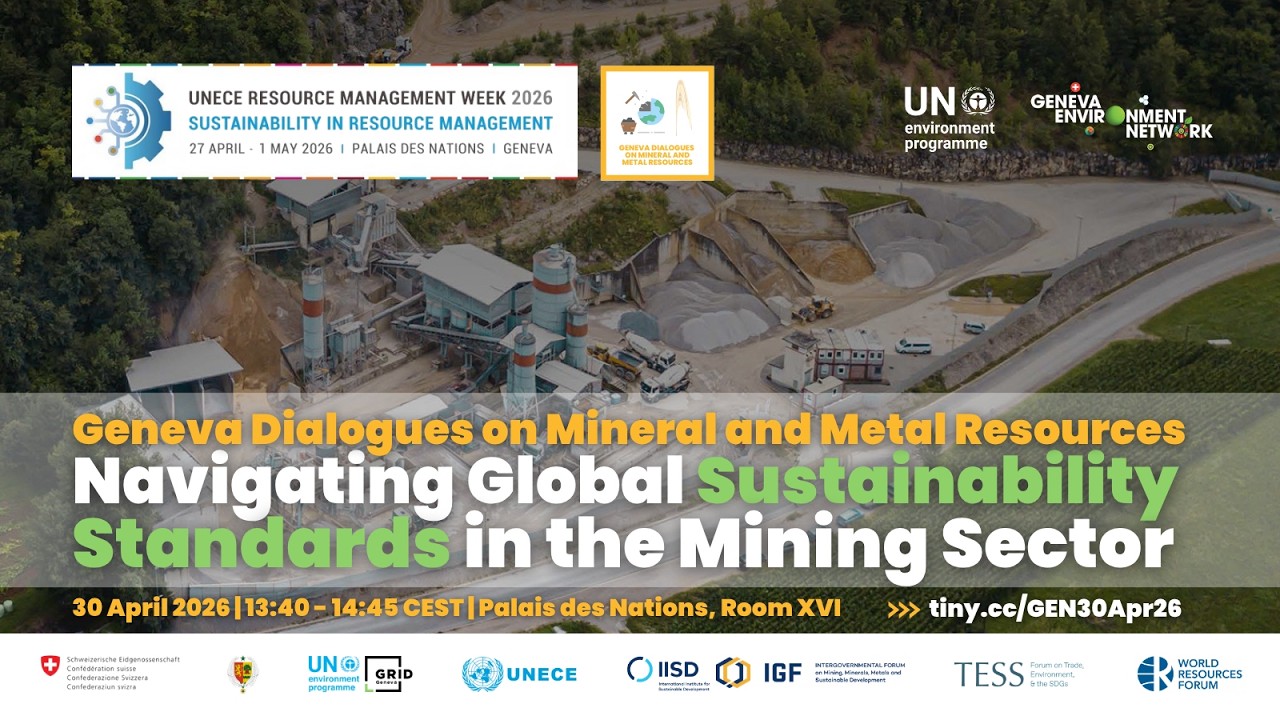
Navigating Global Sustainability Standards in the Mining Sector | UNECE Resource Management Week
Driven by the energy transition, digitalization and major infrastructure development, demand for minerals and metals is raising. This has intensified pressure to ensure that sourcing is responsible and sustainable. Yet governments, particularly in the Global South, face challenges assessing and integrating the growing number of private standards into public policy.
Sustainability Standards and Initiatives are frameworks, systems, schemes or programmes that help actors across minerals and metals supply chains strengthen and meet their sustainability performance. Unlike public instruments, such as laws or treaties, the Sustainability Standards and Initiatives are typically led by the private sector or multi-stakeholder partnerships.
Over the past two decades, their number has doubled. Today, more than 100 such initiatives operate in the minerals and metals sector. This diversity fosters innovation and flexibility, but it also creates a complex and fragmented landscape that can confuse stakeholders and dilute impact.
Building on three United Nations Environment Assembly resolutions (6/5, 5/12, and 4/19) and as part of their 2024 Memorandum of Understanding, the United Nations Environment Programme (UNEP) and the Intergovernmental Forum on Mining, Minerals, Metals and Sustainable Development (IGF) compiled a comprehensive Stocktake of Sustainability Standards and Initiatives for Minerals and Metals. The aim is to clarify how these initiatives interact with laws, regulations and policy commitments, and how they might enhance environmental governance l governance rather than compete with or undermine it.
The Stocktake report Stocktake of Sustainability Standards and Initiatives for Minerals and Metals: Leveraging Synergies Between Sustainability Standards and Initiatives and Public Instruments to Enhance Environmental Governance, released in December 2025, identifies over 100 Sustainability Standards and Initiatives operating across the minerals and metals value chains. While the Sustainability Standards and Initiatives are increasingly used to promote environmental and social performance, the study finds that their rapid proliferation has created a fragmented and often confusing landscape for governments, companies and communities.
The report underscores that well-designed Sustainability Standards and Initiatives can complement—but cannot replace—strong public regulation. Credible and transparent initiatives have the potential to raise sustainability ambition, improve access to environmental data, support compliance and bring diverse stakeholders into decision-making. At the same time, the review warns that fragmentation, high compliance costs and limited relevance to producer-country contexts—particularly in the Global South—remain significant barriers to their effectiveness.
This side event to the UNECE Resource Management Week 2026, organized within the framework of the Geneva Dialogues on Minerals and Metals, will bring together leading experts to discuss the findings of the Stocktake and explore how stakeholders can navigate the evolving landscape of sustainability standards and initiatives.
More information: https://www.genevaenvironmentnetwork.org/events/navigating-global-sustainability-standards-in-the-mining-sector/