
 Geneva Environment Network
305d ago
Geneva Environment Network
305d ago
▶
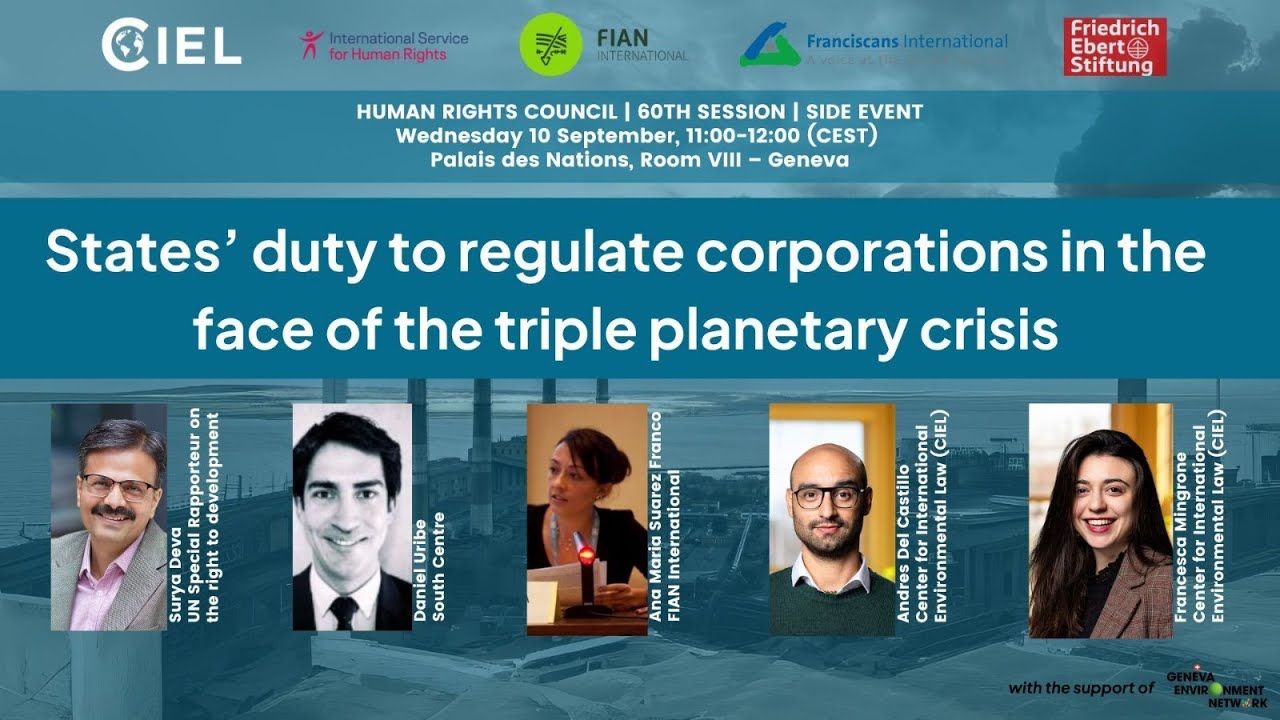
States’ duty to regulate corporations in the face of triple planetary crisis | HRC60 Side Event
Effective regulation of businesses is essential to prevent corporate-led environmental and human rights violations, and ensure effective remedies when harm occurs. Corporate influence is already undermining multilateral fora, for instance in the context of the plastic treaty negotiation, whose last iteration concluded in August 2025 (INC-5.2), as well as limiting States’ ability to put in place effective policies, including through Investor-State Dispute Settlement mechanisms. Fossil fuel corporations are among the main contributors to the triple planetary crisis - climate change, pollution, and biodiversity loss - as many human rights experts have warned.
The open-ended intergovernmental working group on transnational corporations and other business enterprises (OEIGWG), whose eleventh session is set for 20-24 October 2025, provides a key opportunity to establish an international legally binding instrument to regulate, in international human rights law, the activities of transnational corporations and other business enterprises.
A growing body of jurisprudence and findings by human rights institutions at the national, regional, and international levels is being developed on the role that corporate actors - especially transnational corporations and financial institutions - play in fueling the environmental crisis and undermining human rights, including the right to a healthy environment, and corresponding responsibilities of States and corporations. The recent advisory opinion of the International Court of Justice (ICJ) on the obligations of States in respect of climate change addressed the question of corporate accountability, affirming that the “[failure] of a State to take appropriate action to protect the climate system from GHG emissions — including through fossil fuel production, fossil fuel consumption, the granting of fossil fuel exploration licenses or the provision of fossil fuel subsidies — may constitute an internationally wrongful act which is attributable to that State”. Similarly, the Inter-American Court of Human Rights’ landmark Advisory Opinion 32 of 2025 on State obligations in addressing the climate emergency called on States to impose stricter duties on companies with high greenhouse gas emissions, implement the ‘polluter pays’ principle, and strengthen the effectiveness of national mitigation measures. The Framework Principles on Human Rights and the Environment, which outline States’ obligations with regard to the right to a healthy environment, also establish that States must regulate private actors that have the potential to harm the environment and human rights.
This side event will examine the multiple ways in which corporate power is undermining human rights and the environment across different fora and mechanisms. Panelists will reflect on the recent findings of the International Court of Justice and Inter-American Court on Human Rights, and identify key elements and expectations for the eleventh session of the OEIGWG in October 2025. Some concrete cases will be discussed to explore the multiple ways in which corporations are undermining effective policy-making, drawing from examples in the context of the plastic treaty negotiations and ISDS mechanisms, and reflect on solution.
More information: https://www.genevaenvironmentnetwork.org/events/states-duty-to-regulate-corporations-in-the-face-of-triple-planetary-crisis-hrc60-side-event/