
 Geneva Environment Network
1h ago
Geneva Environment Network
1h ago
▶
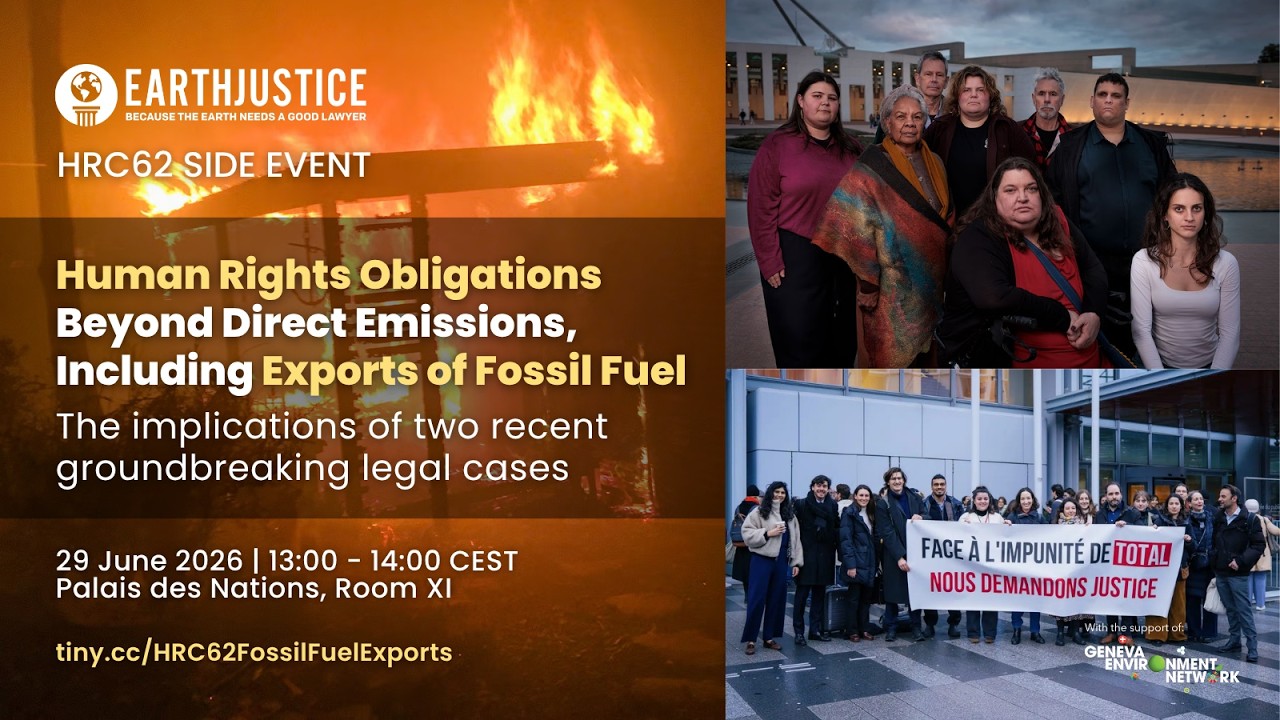
Human Rights Obligations Beyond Direct Emissions, Including Exports of Fossil Fuel | HRC62
The science is irrefutable: global warming is caused by human activities that emit carbon dioxide (CO2) and other greenhouse gases such as methane into the atmosphere of the planet which trap the sun’s radiation around the Earth, leading to a “greenhouse warming effect.” There is now more CO2 in the atmosphere than at any time in the past 800,000 years.
This leads the planetary system to now nearly cross the threshold of average 1.5°C increase above the industrial era and this anthropogenic climate change to already drive catastrophic irreversible human rights impacts. The scientific consensus is that meeting the 1.5°C target requires a rapid and substantial decline in fossil fuel production and use, beginning immediately. At the current annual rate of global greenhouse gas emissions the risks of climate harms escalate with every additional fraction of global warming.
When accounting for their greenhouse gas emissions, States generally do not account for the fossil fuels they export, because it is burned outside their borders. These emissions are also known as “scope 3 emissions”, including all indirect greenhouse gases generated across a company’s or a State’s upstream and downstream value chain. In reality, States do exercise regulatory control over fossil fuel production, including those for export, and the release of emissions from the combustion of fossil fuels—whether within or outside their territory—are an inevitable consequence of that production.
Therefore, States are responsible for breaching their human rights obligations to prevent climate harm through emissions resulting from fossil fuel exports.
On 20 June 2026, ten Australians filed a human rights complaint with the United Nations Human Rights Committee against the Australian government, arguing that by continuing to produce and export large quantities of fossil fuels, Australia has violated their right to life, to family and home life and their right to culture.
They demonstrate that despite knowing about the deadly and foreseeable consequences of climate change for decades, Australia has failed to take the necessary action to prevent climate harms and has materially contributed to climate change as one of the world’s leading historical and current producers and exporters of fossil fuels and that it has no deliberate policy to make the significant export reductions required to prevent dangerous climate harms.
On 25 June 2026, in a ground breaking decision in the case brought by a coalition of associations (Notre Affaire à Tous, Sherpa, ZEA and France Nature Environment) and the City of Paris against the French company TotalEnergies, the Paris Judicial Court ruled that GHG emissions resulting from TotalEnergies’ activities are part of the climate risks included in the scope of the duty of vigilance (Art. L. 225-102-1 of the French Commercial Code) and that scope 3 emissions of parent companies are part of the risks arising from their activities within the meaning of the Due Diligence Act.
Therefore, the court ordered TotalEnergies to integrate scope 3 emissions into its risk mapping and the prevention and mitigation actions of its vigilance plan within six months.
In this event, we will present these two very recent and notable cases with the lawyers involved and discuss the importance of holding States accountable for their exports of fossil fuels.
More information: https://www.genevaenvironmentnetwork.org/events/exports-of-fossil-fuels-and-human-rights-implications-hrc62-side-event/