 CERN
105d ago
CERN
105d ago
▶
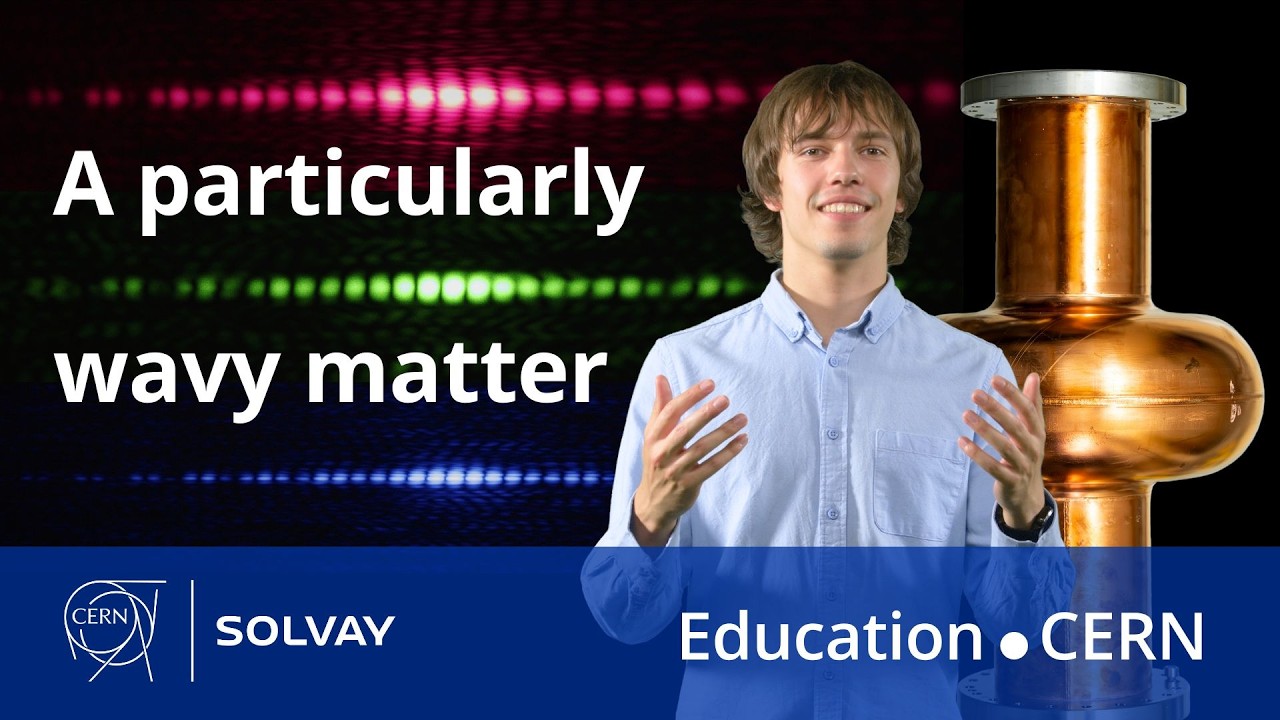
A particularly wavy matter
In physics, waves and particles seem like complete opposites. And yet, at CERN, we could not explore the incredible world of elementary particles without a thorough understanding of wave physics. This #TeachingTuesday, as we wrap up our series explaining the engineering of the LHC to high-school students, we delve into the physics of everyday waves, discover the strange wave-particle duality of quantum objects, and discuss how radiofrequency cavities rely on waves to accelerate particles at the heart of the LHC.
As part of the education portfolio of #CERNScienceGateway, the #CERNSolvayEducation programme was launched by CERN jointly with @SolvayGroup for the #STEMeducation of high-schoolers. It is designed for teenagers who want to go beyond high-school physics and get an introduction to CERN #physics and #technology. In each video, you can test your understanding by answering quiz questions. If you are at least 16 years old, you can enrol for free in the online CERN-Solvay Education Programme towards obtaining a digital certificate, which will allow you to apply for a CERN-Solvay residential student camp.
Find here the interactive version of this video: https://cern.ch/wavy
Enrol for free in the online course of the CERN-Solvay Education Programme: https://cern.ch/solvay-course
Find here all the videos of the CERN-Solvay Education Programme: https://www.youtube.com/playlist?list=PLAk-9e5KQYEpoWZHUQJQHE0bNSJX9bm_O
____________________________________________________
Chapters
0:00-1:36 Introduction
1:36-8:08 How to be like a wave
8:08-16:05 Wave-particle duality
16:05-23:20 Waves in the LHC
____________________________________________________
External works referenced in this video:
Radiofrequency cavity photograph – Matteo Monzali
File:Standard Model of Elementary Particles.svg, Cush, https://en.wikipedia.org/wiki/File:Standard_Model_of_Elementary_Particles.svg
File:Prince Louis-Victor de Broglie (prix Nobel de physique, 13 novembre 1929) - btv1b532220521.jpg https://commons.wikimedia.org/wiki/File:Prince_Louis-Victor_de_Broglie_(prix_Nobel_de_physique,_13_novembre_1929)_-_btv1b532220521.jpg
File:薛定谔肖像.jpg https://commons.wikimedia.org/wiki/File:%E8%96%9B%E5%AE%9A%E8%B0%94%E8%82%96%E5%83%8F.jpg
____________________________________________________
Sources and materials to go further:
Étienne Klein – Petit voyage dans le monde des quanta https://editions.flammarion.com/petit-voyage-dans-le-monde-des-quanta/9782081391550
Natural History Museum – The platypus puzzle
https://www.nhm.ac.uk/discover/the-platypus-puzzle.html
Philip Ball – Beyond Weird https://philipball.co.uk/beyond-weird/
France Culture – Louis de Broglie : électron libre de la physique quantique https://www.radiofrance.fr/franceculture/podcasts/la-science-cqfd/louis-de-broglie-electron-libre-de-la-quantique-7157037
Home.cern – Accelerating: Radiofrequency cavities https://home.cern/science/engineering/accelerating-radiofrequency-cavities