
 US Pharmacopeia
59d ago
US Pharmacopeia
59d ago
▶
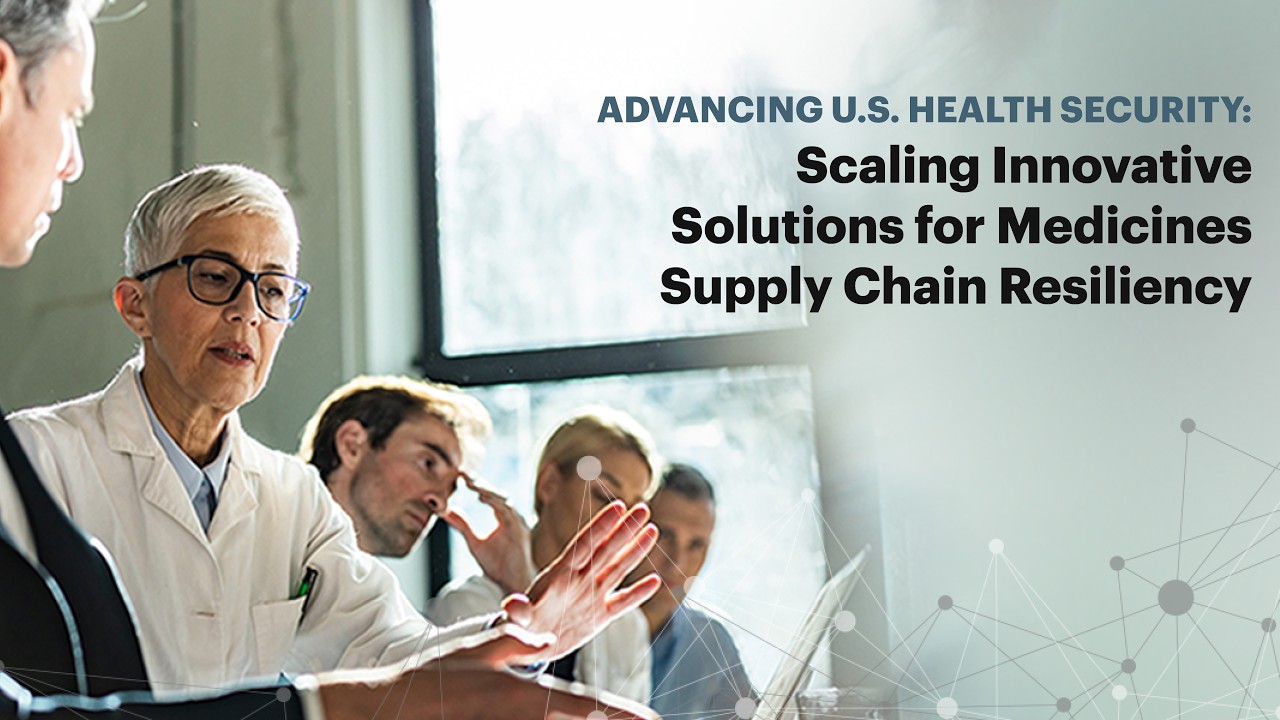
Advancing U.S. Health Security: Scaling Innovative Solutions for Medicines Supply Chain Resiliency
On April 23, the U.S. Pharmacopeia (USP) convened leaders from government, industry, academia, healthcare systems, and advocacy organizations at USP headquarters to for its second USP Resiliency Center event which focused on scaling innovative solutions for medicines supply chain resiliency.
Building on insights from the Resiliency Center launch in February, the event explored solution levers, with an emphasis on technology, innovation, policy, economic incentives, and standards development as mechanisms to strengthen U.S. and global supply chains.
Caitlin Frazer, Executive Director of the National Security Commission on Emerging Biotechnology (NSCEB), joined USP CEO Ronald Piervincenzi for a fireside chat where she emphasized a key message: the United States will not regain historic leadership in biotechnology without urgent action. She highlighted the commission’s achievements and recommendations, including:
• Making biotechnology a national priority through strategic federal leadership
• Incorporating biotechnology in national defense strategy
Mobilizing the private sector to scale innovative solutions
• Building a “workforce of the future” to tap into America’s greatest strength, its people
• Streamlining regulatory processes to accelerate the commercialization of innovations
Next, Jude Nwokike shared learnings from the Resiliency Center’s February event, including case studies in which teams of experts developed action plans for securing the supply of specific medicines during a geopolitical or shortage crisis, evaluating a full range of solution “levers” for impact, practicality, and investment.
Later, Dennis Hall hosted a panel of industry and government leaders who work every day to develop new, more efficient ways to manufacture medicines. The panelists agreed that making U.S.-based manufacturing cost-competitive will require technical innovation, regulatory optimization, and workforce development. Agile, modular, and scalable manufacturing technologies can improve product-switching costs and minimize duplicative regulatory review needed for bespoke systems.
Finally, Anthony Lakavage led a panel discussing opportunities to harness the power of the market to make the medicines supply chain more resilient. Publicly agreed upon metrics for resilience and quality can set a baseline against which procurement incentives can be offered with accountability. Each medicine has its own unique supply chain, so solving for resiliency will require using combinations of levers in different ways, molecule by molecule. Starting with lists of known essential and vulnerable medicines can help us efficiently target our efforts.
Learn more about the USP Resiliency Center: www.usp.org/supply-chain
Timestamps:
0:00:00 Intro
0:00:12 Opening Remarks
• Emily Kaine, MD, SVP Global Health & Manufacturing Services, USP | Chair, Pharmatech Board of Trustees
0:05:53 Opening Fireside Chat
• Caitlin Frazer, Executive Director, National Security Commission on Emerging Biotechnology (NSCEB)
• Ronald T. Piervincenzi, PhD, CEO, USP
0:41:35 USP Resiliency Center Presentation: Feb. 20 Event Recap, Framework and Importance of Standardization Throughout the Supply Chain
• Jude Nwokike, PhD, MSc, MPH, B. Pharm, Vice President, USP Resiliency Center
1:02:54 Scaling Innovative Solutions Across the Supply Chain: Innovative Technologies
• Moderator: Dennis Hall, Vice President, Advanced Manufacturing Technologies, USP
• Matt Callesen, Vice President, Quality, Mark Cuban Cost Plus Drugs
• Andrew Magyar, PhD, Co-Founder, CAPRA Biosciences
• Gabriela Grasa Mannino, PhD, Senior Director, Supply Chain, USP
• Sushma Savarala, PharmD, PhD, Program Manager, Biological Technologies Office, DARPA; Program Manager, ASPR
1:59:47 Scaling Innovative Solutions Across the Supply Chain: Actions to Incentivize Resiliency
• Moderator: Anthony Lakavage, JD, EVP, Secretary, USP Convention and Board of Trustees and Head, Global External Affairs, USP
• Joseph Hamel, Senior Advisor, Enabling Innovations and Technology (EIT), IBMSC, ASPR
• Stephen W. Schondelmeyer, PharmD, PhD, Professor, Department of Pharmaceutical Care and Health Systems, University of Minnesota College of Pharmacy, Twin Cities
• Chandresh Harjivan, MBA, MPH, PharmD, Chief Strategy Officer, Medical Countermeasures Coalition and Advisor, USP
• Mittal Sutaria, PharmD, Senior Vice President, Contract and Program Services, Pharmacy, Vizient, Inc.
2:56:07 Closing Remarks
• Emily Kaine, MD, SVP Global Health & Manufacturing Services, USP | Chair, Pharmatech Board of Trustees