
 International Labour Organization
111d ago
International Labour Organization
111d ago
▶
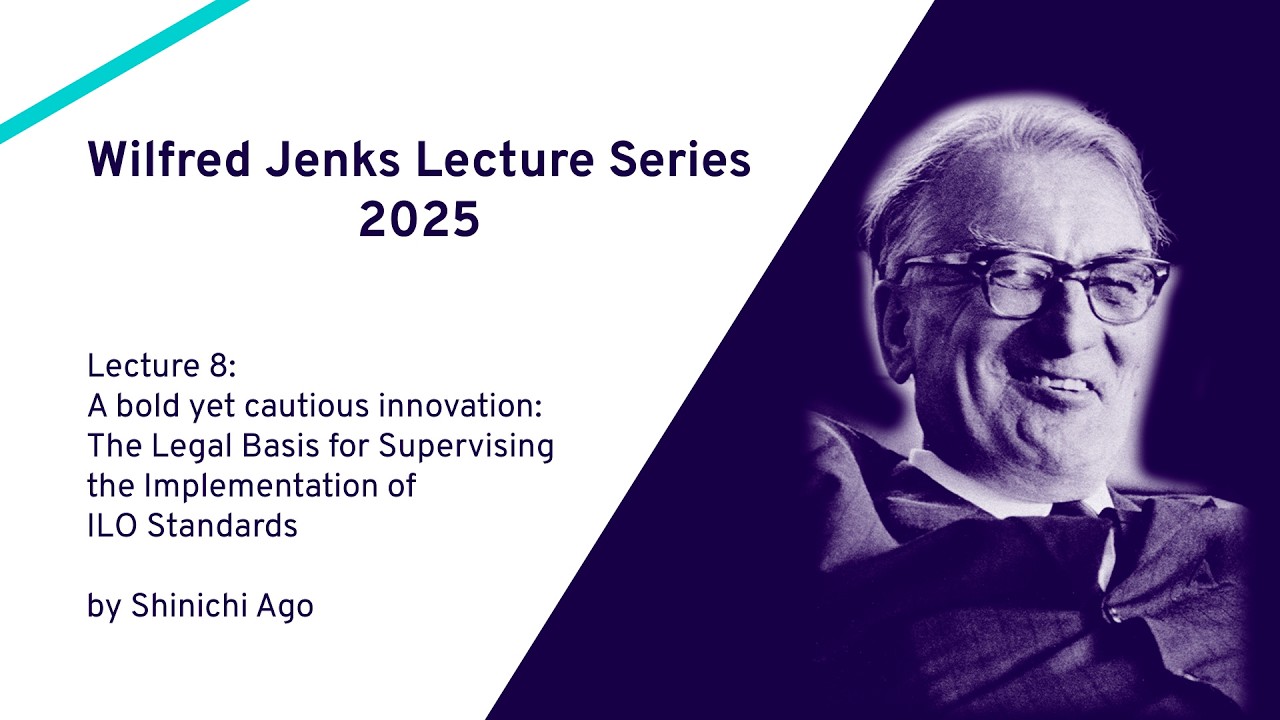
Lecture 08: The legal basis for supervising the implementation of ILO Standards
Lecture 08: A bold yet cautious innovation: The Legal Basis for Supervising the Implementation of ILO Standards
by Shinichi Ago
This lecture examines the legal foundations, historical development, and contemporary significance of the ILO’s system for supervising the application of international labour standards, focusing on what C.Wilfred Jenks called a “bold but cautious innovation.” It argues that although the ILO’s supervisory bodies—particularly the Committee of Experts on the Application of Conventions and Recommendations and the Conference Committee on the Application of Standards—are not explicitly provided for in the ILO Constitution, their authority can be understood as deriving from the implied powers inherent in Articles 19 and 22. Tracing the gradual, practice-driven evolution of these bodies from the 1920s onward, the lecture shows how a modest reporting review mechanism developed into a quasi-judicial system whose accumulated observations resemble case law. The lecture concludes that ILO supervision represents a pioneering model for implementing international law, demonstrating how cautious yet innovative institutional development can generate legitimacy over time and contribute significantly to the effective realization of international law.
About Shinichi Ago
Shinichi Ago is Professor Emeritus of Kyushu University (its former Vice-President and Law Dean). He received both his LL.B. and LL.M. from the University of Tokyo, and obtained his Doctorat ès Sciences Politiques from the University of Geneva (IUHEI).
He has taught public international law in numerous universities both in Japan, as well as abroad, most recently at Ritsumeikan University, Kyoto, where he was Director of the Kyoto Museum for World Peace. Foreign universities taught include Thammasat U, Chulalongkorn U, NU of Singapore, NTaiwan University, Peking U, UC Santa Clara, U of Victoria (Canada) and Sciences Po Bordeaux.
He has advised many governmental institutions in Japan and international organizations. From 2013 to 2022, he was Judge at the Asian Development Bank Administrative Tribunal and since 2015, he is member of the ILO’s Committee of Experts on the Application of Conventions and Recommendations. Since September 2023, he has been admitted to the Tokyo Bar as Attorney-at-Law, mainly providing advisory services to enterprises in business and human rights matters.
His recent publications (in English) include: ‘Supervision of International Labour Standards as a Means of Implementing the Guiding Principles on Business and Human Rights’ European Yearbook of International Economic Law (2019); ‘Benefits and Limits to Labour‑Related Corporate Social Responsibility Codes’, ILO100 Law for Social Justice, ILO Geneva (2019), ‘Complaint Procedure: International Labour Organization (ILO)’ in H Ruiz-Fabri (ed), Max Planck Encyclopaedia of International Procedural Law (OUP 2020), ‘A few thoughts about the concepts of international administrative tribunals and international administrative law’, Asian Journal of International Law, (2022)
About the Wilfred Jenks Lecture Series
The Wilfred Jenks Lecture Series is an initiative of the Office of the Legal Adviser of the International Labour Organization (ILO) aimed at sparking academic reflection, disseminating knowledge and raising awareness about the ILO’s mandate and its legal and normative work. It also seeks to strengthen the ILO’s long-standing ties with legal scholars and practitioners. This initiative has its origins in the ILO100 Law for Social Justice academic conference, which took place in 2019 during the celebrations of the ILO’s centenary and which resulted in the ILO100 Law for Social Justice publication.
The story of CW Jenks’ over 40 years of service exemplifies the foresight and leadership
needed.