
 CGIAR Climate Impact Platform
247d ago
CGIAR Climate Impact Platform
247d ago
▶
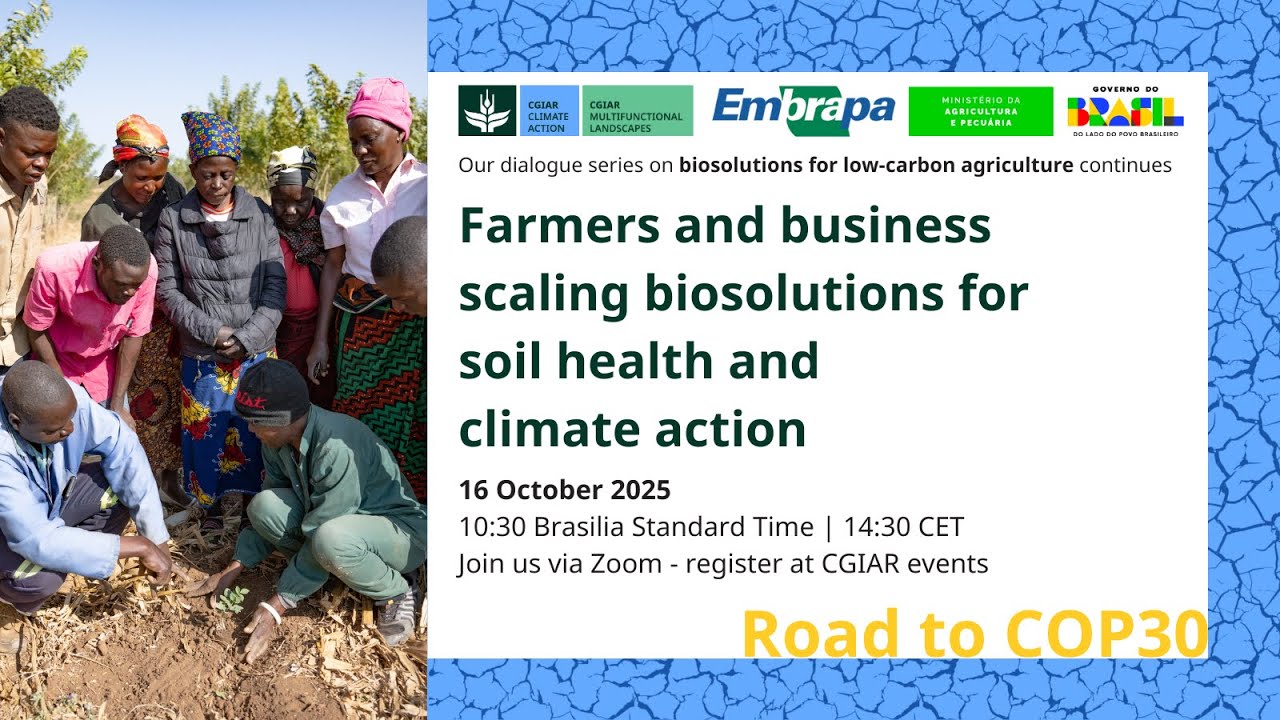
Farmers and business scaling biosolutions for soil health and climate action
Second Dialogue | 16 October 2025 | Farmers and business scaling biosolutions for soil health and climate action
This webinar explored how to harness the potential of these solutions through innovative business models, analytics, and decision-support tools to advance agricultural sustainability across Africa, Asia and the Americas, with particular attention to Brazil's pioneering progress and lessons for supporting the broader uptake of these approaches globally, ensuring smallholder farmers are at the forefront of transformation.
Effective soil health action requires systematic and inclusive monitoring to prioritize interventions and track their impact across diverse biophysical, social, and economic contexts. Key monitoring innovations include using quantitative indicators, landscape-scale assessments leveraging systematic sampling and machine learning, and cost-effective methods like soil spectroscopy (reducing analysis costs by up to 90%). Furthermore, citizen science enables community engagement and scales data collection. These technical advancements must be paired with multi-stakeholder action and locally-led management, which include on-farm production of bio-inputs, farmer-to-farmer knowledge sharing, and adoption of technologies like biological nitrogen fixation and biological nitrification inhibition. Additional strategies involve sustainable nutrient stewardship through tools like AgWise, circular bioeconomy models, and payment for ecosystem services, all supported by geo-targeting analytics to scale low-carbon solutions globally, drawing on proven models from regions like Brazil.
This webinar series, organized by CGIAR Climate Action, alongside the Brazilian Ministry of Agriculture and Livestock (MAPA), Embrapa, and CGIAR Multifunctional Landscapes, have demonstrated the power of biological solutions as both climate adaptation tools and mitigation co-benefits, showcasing real-world applications across agrifood systems to identify strategic policy actions that COP30 can catalyze to achieve climate-resilient agricultural economies at scale.