

▶
C. Borgogna - IFI16 Relocalization to the Cytoplasm ControlsRNA Virus Replication
Cinzia Borgogna, Associate Professor of Microbiology, University of Piemonte Orientale Dept. of Translational Medicine, Novara (ITALY) speaks on "IFI16 Relocalization to the Cytoplasm Controls
RNA Virus Replication".
Abstract
Interferon gamma-inducible protein 16 (IFI16) is best known as a nuclear
DNA sensor that activates innate immune signaling, but it also exerts direct
antiviral functions during RNA virus infection. In our study, we observed that infection with human coronaviruses induces IFI16 relocalization to the
cytoplasm, positioning it at sites of viral replication. During SARS-CoV-2
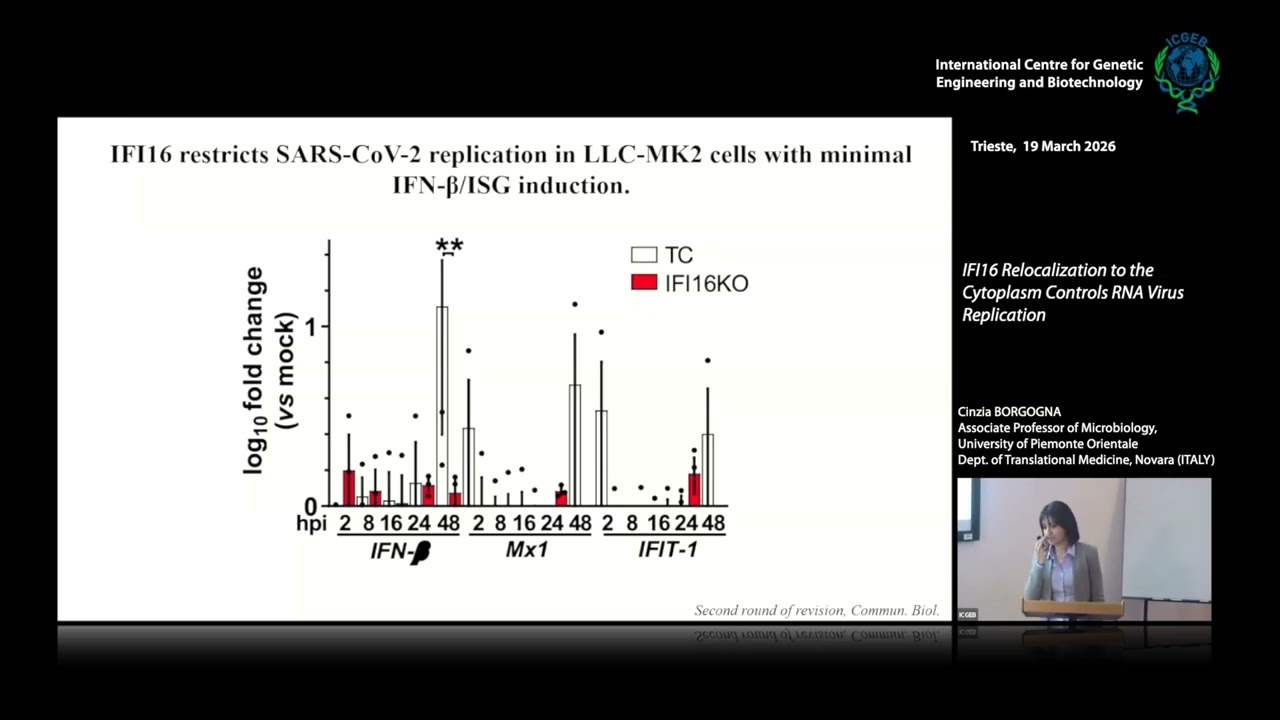
infection, cytoplasmic IFI16 associates with viral RNA and the nucleocapsid (N) protein and restricts replication by disrupting N–RNA–driven liquid–liquid phase separation required for efficient replication and assembly. Consistently,
IFI16 loss enhances viral replication and promotes the early formation of
large perinuclear N-rich condensates, supporting a model in which IFI16
restrains the formation of viral replication/assembly compartments. When
we extended these observations to additional human coronaviruses, IFI16
depletion enhances OC43 replication but reduces NL63 replication, indicating that while cytoplasmic relocalization is conserved, the functional outcome is virus-specific. Beyond coronaviruses, we also observed that infection with diverse RNA viruses (including flaviviruses and rhabdoviruses) promotes IFI16 cytoplasmic accumulation, suggesting a broader antiviral program. Because RNA virus infection and dsRNA stress induce stress-granule formation, we investigated whether IFI16 contributes to this pathway. Structural prediction and surface plasmon resonance analyses revealed a direct interaction between IFI16 and the stress-granule nucleator G3BP1, which was further supported in SARS-CoV-2–infected cells by proximity ligation assays demonstrating their cytoplasmic association early during infection. Using poly(I:C) as a surrogate of viral dsRNA, IFI16-deficient cells exhibited a higher number and increased size of G3BP1-positive stress granules compared with IFI16-proficient cells. This phenotype was associated with enhanced colocalization of PKR with dsRNA, consistent with increased dsRNA sensing and PKR activation in the absence of IFI16.
Overall, our findings identify cytoplasmic IFI16 as a multifunctional regulator of RNA virus replication through its effects on RNA condensates and stress-granule dynamics.