
 Council on Foreign Relations
49d ago
Council on Foreign Relations
49d ago
▶
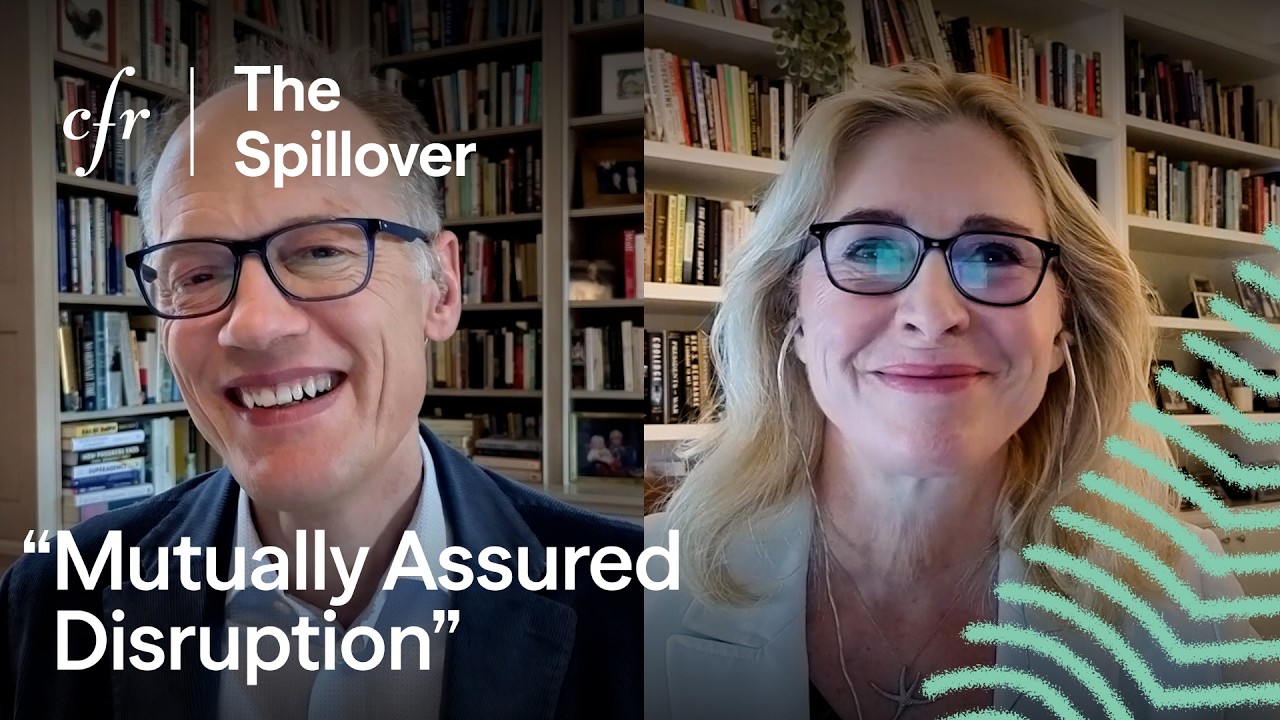
Trump-Xi + Mutually Assured Disruption + Boeing, Beef, and Beans | The Spillover
President Donald Trump is set to meet with Xi Jinping in Beijing for a high-stakes summit shaped by Iran war tensions, trade disputes, critical mineral flows, semiconductor controls, and an intensifying AI race. This episode breaks down the growing U.S.-China rivalry, the risks facing global markets and supply chains, and whether the world is entering a new era of economic fragmentation and technological competition.
Hosts:
Rebecca Patterson, Senior Fellow, Council on Foreign Relations (CFR) - https://www.cfr.org/experts/rebecca-patterson
Sebastian Mallaby, Paul A. Volcker Senior Fellow for International Economics, Council on Foreign Relations (CFR) - https://www.cfr.org/experts/sebastian-mallaby
We discuss:
1. How President Trump’s high-stakes summit with Chinese President Xi Jinping comes at a moment of intense rivalry over AI, trade, semiconductors, and Taiwan.
2. How the United States and China are locked into “mutually assured disruption” when it comes to trade, with China controlling critical rare-earth minerals and the U.S. restricting advanced AI chip exports.
3. As Rebecca Patterson puts it: “If there’s not a happy hug between Trump and Xi on rare-earth minerals and chips, that might be problematic.”
4. Whether Chinese AI firms like DeepSeek are catching up to American companies such as OpenAI and Anthropic despite U.S. semiconductor restrictions.
5. The growing debate over AI safety and whether Washington and Beijing can cooperate on preventing dangerous applications of artificial intelligence while still competing for dominance.
6. Why Taiwan remains the single biggest geopolitical risk hanging over global markets, semiconductor supply chains, and the future of the AI economy.
7. How fears of a Taiwan crisis could ripple through global stock markets, especially tech and semiconductor companies tied to firms like TSMC, Nvidia, Intel, and Samsung.
8. Why tariffs and supply chain disruptions continue to reshape global trade, with companies and governments from Europe to Southeast Asia forced to navigate a more fragmented global economy.
00:00 - Introduction to The Spillover
00:59 - Today’s Topics: AI, Taiwan, & Trade
01:13 - US-China AI Race & Semiconductors
06:38 - AI Safety & Cold War Parallels
10:50 - Silicon Valley & The AI Bubble
15:40 - Global Markets & Technology Risks
16:40 - Taiwan Geopolitics & Arm Sales
20:30 - TSMC & Semiconductor Supply Chains
22:15 - Regional Defense & Nuclear Security
25:02 - US-China Trade & Tariff Escalation
28:45 - Reshoring & Economic Decoupling
35:28 - China’s Strategic Goals & Stability
41:10 - Currency Shifts & The Global Dollar
49:30 - Economic Outlook & AI Adoption
Mentioned on the Episode:
“At the Trump-Xi Summit, China Will Have the Upper Hand,” CFR.org - https://www.cfr.org/articles/at-the-trump-xi-summit-china-will-have-the-upper-hand
Chris McGuire, “How Trump Should Approach AI Talks With China: Targeted Dialogue, Maximum Pressure,” CFR.org - https://www.cfr.org/articles/how-trump-should-approach-ai-talks-with-china-targeted-dialogue-maximum-pressure
“Global Supply Chain Pressure Index (GSCPI),” Federal Reserve Bank of New York - https://www.newyorkfed.org/research/policy/gscpi#/interactive
Ryan Mancini, “Trump’s Approval on Economy Hits New Low; 7 in 10 Expect Recession Next Year: Poll,” The Hill - https://thehill.com/business/5873663-donald-trump-approval-economy-recession-fears-survey/
Xinyi Wu, “China, Indonesia Launch Cross-Border QR Payments – A Boost for the Global Yuan?,” South China Morning Post - https://www.scmp.com/economy/global-economy/article/3352360/china-indonesia-launch-cross-border-qr-payments-boost-global-yuan
Want to keep up with The Spillover? Sign up to receive an email alert when new episodes are released at http://cfr.org/newsletters/#podcasts
The Spillover is a production of the Council on Foreign Relations. The opinions expressed on the show are solely those of the hosts and guests, not of the Council, which takes no institutional positions on matters of policy.