
 IESR Indonesia
55d ago
IESR Indonesia
55d ago
▶
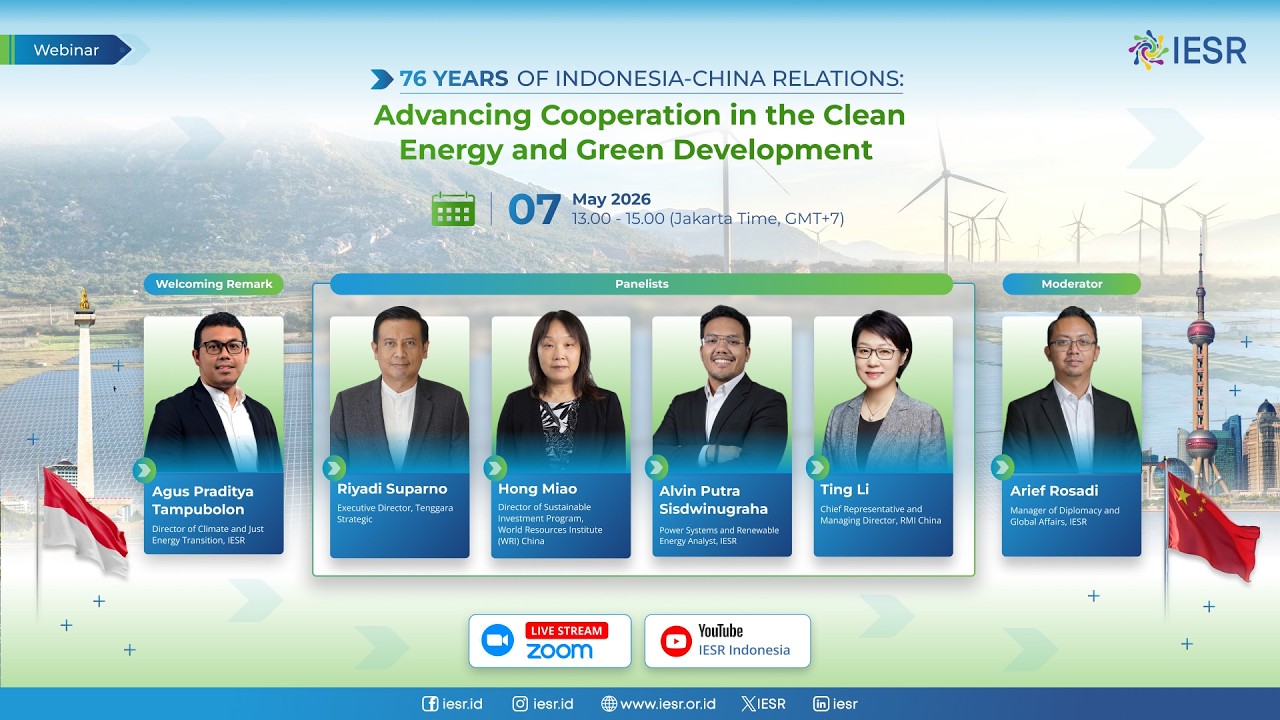
76 Years of Indonesia-China Relations: Advancing Cooperation in Clean Energy and Green Development
2026 marks the 76th anniversary of diplomatic relations between Indonesia and China. As two of the world’s fastest-growing economies (PWC, 2017), both countries have deepened cooperation through trade, investment, and strategic initiatives, including the Belt and Road Initiative (BRI). China has remained Indonesia’s largest trading partner for over a decade (China Briefing, 2024), while Indonesia continues to be a major destination for BRI investments (GFDC, 2026). Beyond economic ties, people-to-people connections have also flourished, with approximately 20.000 Indonesian students studying in China (Kompas, 2026) and Chinese tourist arrivals in Indonesia surpassing 1.34 million throughout 2025, the highest level in the past six years (Xinhua, 2026).
Yet, as both nations navigate the urgent global challenge of climate change, there remains untapped potential for deeper collaboration in clean energy and green development. China’s global leadership in renewable energy deployment and manufacturing (GEM, 2024) presents a significant opportunity to support Indonesia’s transition toward a low-carbon energy system. However, a substantial portion of China’s cumulative investment in Indonesia—amounting to approximately US$49.37 billion between 2005 and 2025 with at least US$11.81 billion directed to the energy sector—has been concentrated in fossil fuel-related sectors, including oil and gas, mining, and conventional power generation (American Enterprise Institute, 2026). At the same time, Indonesia requires an estimated US$30–40 billion annually through 2050 to achieve its energy transition targets (IESR, 2024). Recent policy directions, including China’s latest Five-Year Development Plan, which emphasizes green development, renewable energy expansion, and industrial upgrading, are increasingly aligned with Indonesia’s priorities in accelerating energy transition and promoting sustainable economic growth. However, this alignment has yet to be fully translated into concrete and scaled implementation, as investment flows and technical cooperation in low-carbon sectors remain limited (Jakarta Globe, 2026). This highlights the need to better operationalize bilateral cooperation by redirecting investments toward renewable energy, green infrastructure, and low-carbon industrial development, while strengthening collaboration in areas such as technology transfer, green finance, and clean energy deployment.
Against this backdrop, the Institute for Essential Services Reform (IESR) will convene a regional webinar titled “76 Years of Indonesia-China Relations: Advancing Cooperation in Clean Energy and Green Development”. The webinar aims to serve as a strategic platform for dialogue among policymakers, industry actors, financial institutions, and research organizations to explore opportunities for enhanced collaboration. By leveraging China’s technological and financial capabilities alongside Indonesia’s abundant renewable energy resources, both countries can advance a model of South–South cooperation that aligns economic growth with climate ambition and sustainable development.
Objectives
- To facilitate strategic dialogue between Indonesian and Chinese stakeholders on advancing bilateral cooperation in clean energy and green development.
- To orchestrate potential areas of cooperation into concrete technical collaboration, particularly in scaling up renewable energy investment and redirecting existing investment flows toward low-carbon sectors.