

▶
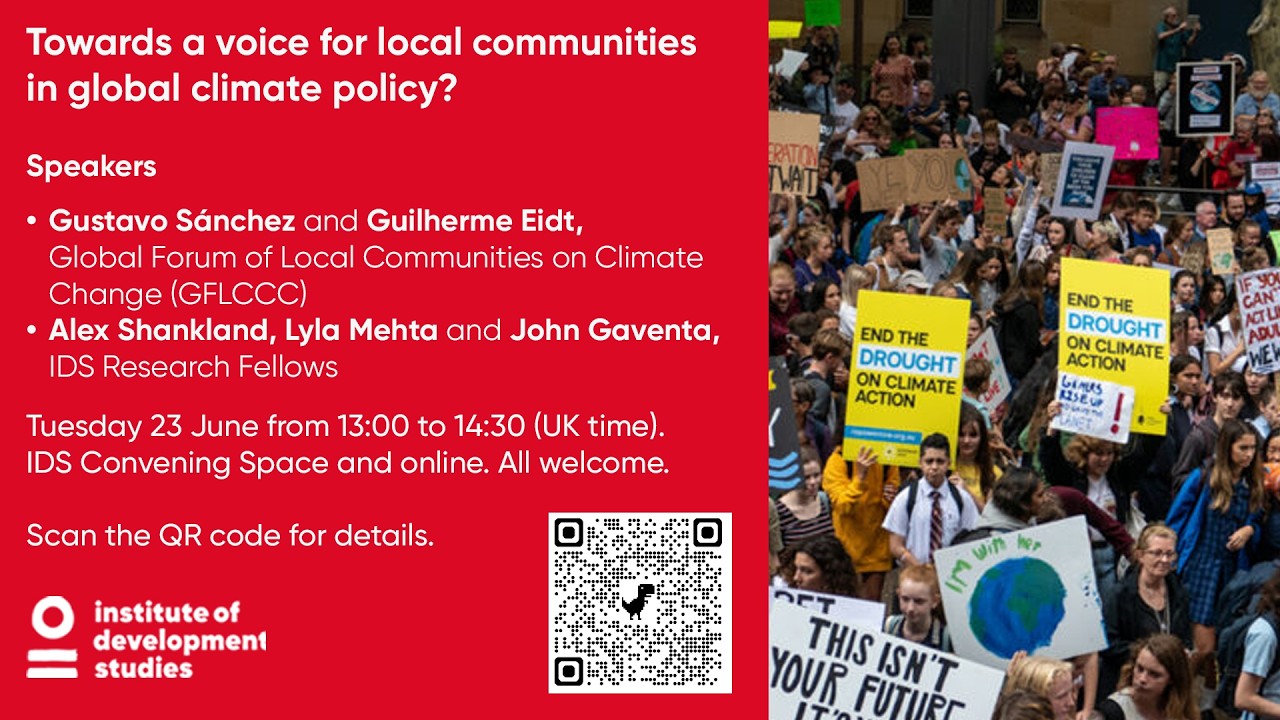
Towards a voice for local communities in global climate policy?
In recent months, hope has grown that we may be approaching a breakthrough moment for the voice and visibility of front-line communities in the global climate policy process. Held to mark London Climate Action Week, this seminar will review the progress that has been made since COP30 in Brazil, and discuss possible strategies for overcoming the challenges that remain.
Eight years ago, COP24 of the UN Framework Convention on Climate Change (UNFCCC) established a ‘Local Communities and Indigenous Peoples Platform’ (LCIPP) and promised that ‘local communities’ – pastoralists, artisanal fishers, forest communities, Afrodescendants and members of other ‘traditional peoples’ who do not necessarily identify as Indigenous – would have a voice alongside Indigenous Peoples.
To this day, however, LCIPP representation has been open only to Indigenous Peoples and national governments. This has left unrepresented millions of people who exercise customary stewardship over ancestral territories that cover a significant proportion of the world’s forests, savannahs, mountains and wetlands. These territories are on the front line of old and new threats, from ever-expanding agribusiness frontiers to the new scramble for critical minerals.
After many years of limited progress, in recent months the global climate policy process has finally shown signs of willingness to make good on the longstanding promise of an officially-recognised space where local communities can be heard alongside Indigenous Peoples.
This has followed from significant progress in recent conferences of the UNFCCC’s ‘sister conventions’, the United Nations Convention to Combat Desertification (UNCCD) and the Convention on Biological Diversity (CBD). COP16 of the CBD in Colombia gave unprecedented recognition to the rights of Afro-descendant communities as knowledge-holders and stewards of biodiversity, and Mongolia, the host of the upcoming COP17 of UNCCD, will recognise the critical importance of pastoralist territories by hosting the largest-ever Global Pastoralist Gathering, a key event in the UN International Year of Rangelands and Pastoralists.
Fresh from a UNCCD preparatory meeting of pastoralist communities in Brazil and the SB64 climate negotiations in Bonn, Gustavo Sánchez and Guilherme Eidt, two key members of the Global Forum of Local Communities on Climate Change (GFLCCC), will discuss the importance of establishing representation of local communities in the UN Framework Convention on Climate Change (UNFCCC) – and of the grassroots action and alliance-building that will be needed to turn formal recognition at the global level into genuine transformation of the situation on the ground.
In a discussion chaired by John Gaventa, editor of a recent IDS Bulletin on voices from the front line of energy transition, IDS researchers Alex Shankland and Lyla Mehta will reflect on the perspectives shared by Gustavo and Guilherme in the light of IDS research on the contested politics of climate knowledge and the potential for transformation from below.
Speakers
Gustavo Sánchez, President of Red MOCAF (Mexico) and co-founder of the GFLCCC;
Guilherme Eidt, Executive Secretary of the GFLCCC;
Alex Shankland, IDS Research Fellow.
Discussant: Lyla Mehta, IDS Research Fellow.
Chair: John Gaventa, IDS Research Fellow.