
 EduSkills OECD
145d ago
EduSkills OECD
145d ago
▶
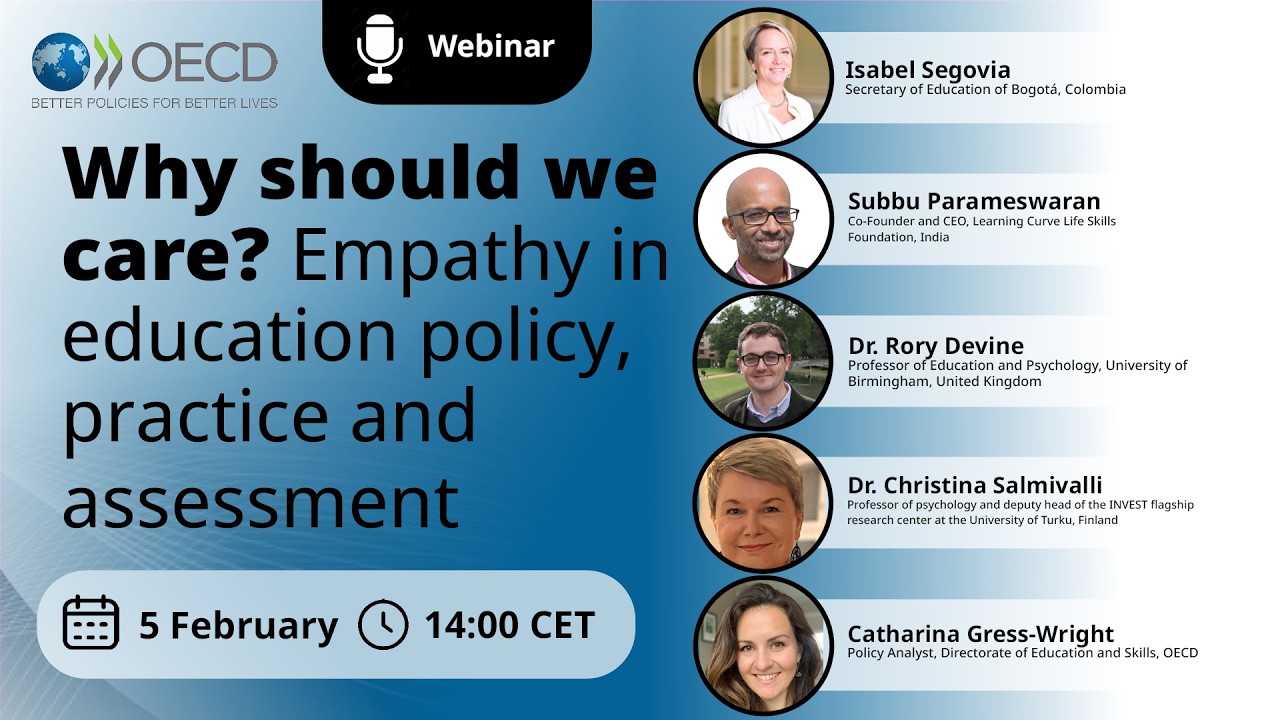
Webinar | Why should we care? Empathy in education policy, practice and assessment
Empathy plays a central role in how children interact with others, build relationships and contribute to supportive and inclusive schools. It matters for cohesive, peaceful societies. Yet while many recognise its importance, education systems still struggle to define empathy, teach it and create policies and assessments to support and monitor its development.
In this webinar, we explored why empathy matters for education systems and how it can be measured, understood and implemented. Bringing together global perspectives from research, policy and practice, the discussion examined how we can support system-level strategies and school-based initiatives that foster empathy, children’s wellbeing, and positive school climates.
This webinar draws on the innovative work on empathy by the OECD’s Survey on Social and Emotional Skills (SSES). In 2026, the SSES will assess empathy in a dedicated assessment for the first time, creating comparable data from nearly 20 countries.
Speakers included:
Isabel Segovia, Secretary of Education of Bogotá, Colombia
Subbu Parameswaran, Co-Founder and CEO, Learning Curve Life Skills Foundation, India
Dr. Rory Devine, Professor of Education and Psychology, University of Birmingham, United Kingdom
Dr. Christina Salmivalli, Professor of psychology and deputy head of the INVEST flagship research center at the University of Turku, Finland
Moderated by Catharina Gress-Wright, Policy Analyst, Directorate of Education and Skills, OECD
Resources from the webinar:
If you would like to keep up to date with all OECD work on education, please sign up to our monthly newsletter, available here: https://oe.cd/EDUnewsletter
If you would like to see the recording of the webinar or check out any previous webinars please find them at https://oecdedutoday.com/webinars/
Our SSES 2023 report, Volume I (published April 2024). Shows how empathy changes with age and gender and how it relates to important outcomes like wellbeing and career expectations - https://www.oecd.org/en/publications/social-and-emotional-skills-for-better-lives_35ca7b7c-en/full-report.html
The SSES 2023 report, Volume II (published October 2024). Schools and families can help or hinder empathy through the simplest things, like providing feedback or sharing chores equally between genders at home. https://www.oecd.org/en/publications/nurturing-social-and-emotional-learning-across-the-globe_32b647d0-en/full-report.html
Our SSES Working Paper 1 (2023). Summarises research about empathy, showing it is teachable and relates to important outcomes like civic engagement and wellbeing - https://www.oecd.org/en/publications/social-and-emotional-skills-ses_ba34f086-en.html
1. Bogodatos semestrales y temáticos - Oficina de Convivencia Escolar: https://oce.educacionbogota.edu.co/bogodatos-semestrales-y-tematicos
2. Malla de aprendizajes en habilidades socioemocionales - Oficina de Convivencia Escolar: https://oce.educacionbogota.edu.co/repositorio/malla-de-aprendizajes-en-habilidades-socioemocionales
From Dr. Rory Devine, Professor of Education and Psychology, University of Birmingham, United Kingdom:
This paper talks about the links between mental health, neurodiversity and empathy in children:
https://acamh.onlinelibrary.wiley.com/doi/abs/10.1002/jcv2.70034
This paper talks about the links between cross-ethnic friendships, classroom diversity and empathy in children:
https://srcd.onlinelibrary.wiley.com/doi/full/10.1111/cdev.14085
Findings of the KiVa program and the effects on Bullying and Empathy (2021) https://doi.org/10.1080/15374416.2020.1846541